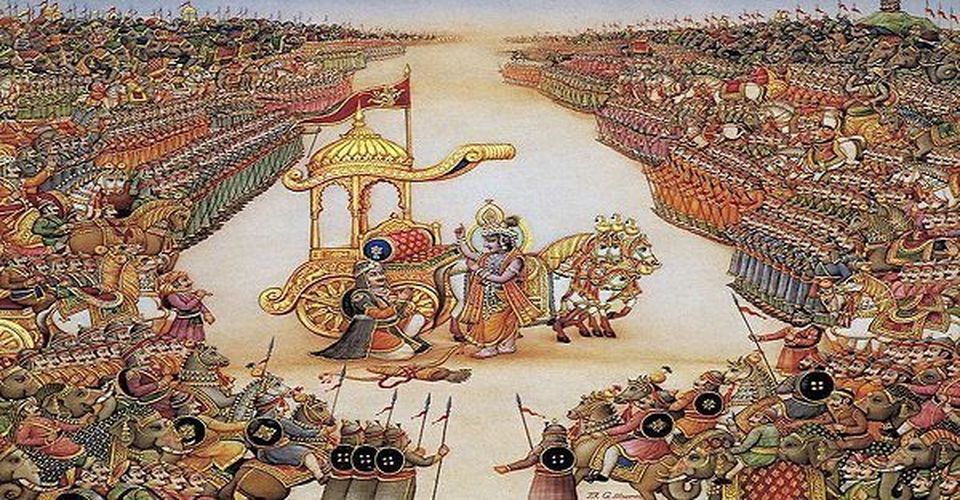
The Battle of Kurukshetra.

The battle of Kurukshetra took place at Kurukshetra, Haryana, India, just about 150 air kilometers north of New Delhi, on the way to Chandigarh.

It took place roughly 5000 years ago and in 730711BG.Lon (Bhagavad-gita class of July 11th 1973 in London) and in other passages, Srila Prabhupada says:”sixty-four crores of men were killed on the Battlefield of Kuruksetra.”

64 crores mean 640 million

640 million represents about 8.20 % of the current world population in 2020 figures.

According to https://www.worldometers.info/world-population/, the current world population is 7.8 billion and increasing fast. (again 2020 figures)

“Men” also means only male soldiers, generals, princes and kings from the whole world. The world’s administrative centre was Hastinapura, the current New Delhi. No women or children were involved in the killing, as the population was much more pious and did not have to suffer in wars the reactions for their sinful activities.

The Bhagavad-gita was spoken by Sri Krishna, the Supreme Personality of Godhead, personally present on the battlefield, to Arjuna and the rest of the world just before the battle. It was spoken in half an hour, at the most one hour and is meant for everyone.

It appears that the talks between the master and the disciple were exchanged openly in the presence of both armies so that all of them were benefitted. The talks of Bhagavad-gita therefore, are not specifically directed at any particular person, society or community, but they are for all, including friends or enemies.” Bhagavad-Gita 2.10. Version 3.

Posted in Uncategorized | Leave a comment

Indigestion caused by excessive intake of ghee and how to cure it by Srila Prabhupada.

Sometimes people complain that Hare Krishna prasadam (sanctified food) contains too much ghee.

In Caitanya Caritamrta, Adi 10.49, purport, we learn that even Lord Caitanya Himself was victimized by such practice:

“Once Shivananda Sena offered food to Lord Caitanya that had been cooked with excessive ghee, and the next day the Lord became sick and went to Murari Gupta for treatment. Lord Caitanya accepted some water from the waterpot of Murari Gupta, and thus He was cured. The natural remedy for indigestion is to drink a little water, and since Murari Gupta was a physician, he gave the Lord some drinking water and cured Him.” Copyrights BBT.

Once I took dinner at

Govinda’s – Food for Life

Vegetarian/Vegan Restaurant
194 William St
6000 Northbridge, (PERTH) Western Australia.

and as a direct result, at about 1 or 2 am the next morning, I woke up and had to evacuate very quickly mostly fluid to avoid a total mess. I was staying in my Sankirtan travelling van in Kings Park more or less legally. This is one of the reasons City Councils forbid and strictly enforce laws against freelance camping. In tourist places like Broome, Western Australia, Council Ranger just impose a hefty fine without a single word being exchange with the so-called offender, whether awake or sleeping.

Later it was admitted that the cook may have used too much ghee. It was all handled in the thirst person, but I got an idea that the temple president himself was the actual cook.. What a disturbance to my book distribution program it was anyway! When one goes to India and just drinks any water, one gets sick immediately because of chronic pollution. Naturally a country of 1.4 billion will produced a lot of waste. We don’t really want similar conditions in our so-called Western countries because of the cook’s unfavorable mental state. This is definitely not welcome.

The same happened to me after taking breakfast at ISKCON Adelaide, South Australia. and again what a disturbance to my book distribution program it was. Luckily I could find a toilet very quickly in what was for me new and foreign terrain at the time. I was staying at ISKCON Adelaide.

The best remedy to cure the material disease of the spirit soul is to chant as much as possible:

HARE KRISHNA HARE KRISHNA

KRISHNA KRISHNA HARE HARE

HARE RAMA HARE RAMA

RAMA RAMA HARE HARE

The recommended number of mantras is a minimum of 1728 daily mantras, which represents two hours of dynamic meditation.

CC Adi 10.51, purport by Srila Prabhupada:

“Murari Gupta could treat both bodily and spiritual disease because he was a physician by profession and a great devotee of the Lord in terms of spiritual advancement. This is an example of service to humanity. Everyone should know that there are two kinds of diseases in human society. One disease, which is called adhyatmika, or material disease, pertains to the body, but the main disease is spiritual. The living entity is eternal, but somehow or other, when in contact with the material energy, he is subjected to the repetition of birth, death, old age and disease. The physicians of the modern day should learn from Murari Gupta. Although modern philanthropic physicians open gigantic hospitals, there are no hospitals to cure the spiritual disease of the spirit soul. The Krishna consciousness movement has taken up the mission of curing this disease, but people are not very appreciative because they do not know what this disease is. A diseased person needs both proper medicine and a proper diet, and therefore the Krishna consciousness movement supplies spiritually stricken people with the medicine of the chanting of the holy name, or the Hare Krishna mahä-mantra, and the diet of prasadam. There are many hospitals and medical clinics to cure bodily diseases, but there are no such hospitals to cure the spiritual disease of the spirit soul. The centers of the Krishna consciousness movement are the only established hospitals that can cure man of birth, death, old age and disease.” Copyright BBT

Posted in Uncategorized | Leave a comment

KRISHNA CONSERVATIONISM. Caitanya Caritamrita, Adi 9.46. Copyrights with BBT.

TEXT 46

aho esäm varam janma
sarva-präny-upajivinäm
su-janasyeva yesàm vai
vimukhä yänti närthinah

SYNONYMS
aho—oh, just see; esäm—of these trees; varam—superior; janma—birth; sarva—all; präni—living entities; upajivinäm—one who provides maintenance; su-janasya iva—like the great personalities; yesäm—from whose; vai—certainly; vimukhäh—disappointed; yänti—goes away; na—never; arthinah—one who is asking for something.

TRANSLATION
”’Just see how these trees are maintaining every living entity! Their birth is successful. Their behavior is just like that of great personalities, for anyone who asks anything from a tree never goes away disappointed.’”

PURPORT
According to Vedic civilization, kshatriyas are considered to be great personalities because if anyone goes to a kshatriya king to ask for charity, the king will never refuse. The trees are compared to those noble kshatriyas because everyone derives all kinds of benefits from them—some people take fruit, others take flowers, others take leaves, others take twigs, and others even cut the tree, and yet the tree gives to everyone without hesitation.

Unnecessarily cutting trees without consideration is another example of human debauchery. The paper industry cuts many hundreds and thousands of trees for its mills, and with the paper so much rubbish literature is published for the whimsical satisfaction of human society. Unfortunately, although these industrialists are now happy in this life by dint of their industrial development, they do not know that they will incur the responsibility for killing these living entities who are in the form of trees.

This verse, quoted from Shrimad-Bhägavatam (10.22.33), was spoken by Lord Krishna to His friends when He was taking rest underneath a tree after His pastime of stealing the clothes of the gopis (vastra-harana-lilä). By quoting this verse, Caitanya Mahäprabhu teaches us that we should be tolerant like trees and also beneficial like trees, which give everything to the needy persons who come underneath them. A needy person may derive many advantages from trees and also from many animals, but in modern civilization people have become so ungrateful that they exploit the trees and animals and kill them. These are some of the sinful activities of modern civilization.

Posted in Uncategorized | Leave a comment

THE SANKIRTAN MOOD. CC Adi 9.29 Copyright BBT.

TEXT 29

mäge vä nä mäge keha, pätra vä apätra
ihära vicära nähi jäne, deya mätra

SYNONYMS
mäge—begs; vä—or; nä—not; mäge—begs; keha—anyone; pätra—candidate; vä—or; apätra—not a candidate; ihära—of this; vicära—consideration; nähi—does not; jäne—know; deya—gives; mätra—only.

TRANSLATION
Not considering who asked for it and who did not, nor who was fit and who unfit to receive it, Caitanya Mahäprabhu distributed the fruit of devotional service.

PURPORT
This is the sum and substance of Lord Caitanya’s sankirtana movement. There is no distinction made between those who are fit and those who are not fit to hear or take part in the sankirtana movement. It should, therefore, be preached without discrimination. The only purpose of the preachers of the sankirtana movement must be to go on preaching without restriction. That is the way in which Shri Caitanya Mahäprabhu introduced this sankirtana movement to the world.

Posted in Uncategorized | Leave a comment

A very old voice, the voice of His Divine Grace Krishna Das Kaviraja Goswami, author of Sri Caitanya Caritamrita.


There is a very old voice of the sixteenth century, which speaks to us through the centuries and that voice is the voice of the author of Sri Caitanya Caritamrta, His Divine Grace Krishna Das Kaviraja Goswami and, in Caitanya Caritamrta Adi 8.13, in his original Bengali language, he says the following: 

TEXT 13

ataeva punah kahon ürdhva-bähu hanä

caitanya-nityänanda bhaja kutarka chädiyä

Word for word rendition.

ataeva—therefore; punah—again; kahon—I speak; ürdhva—lifting; bähu—arms; hanä—so doing; caitanya—Shri Caitanya Mahäprabhu; nityänanda—Lord Nityänanda; bhaja—worship; kutarka—useless arguments; chädiyä—giving up.

TRANSLATION

Therefore I say again, lifting my arms: O fellow human beings, please worship Shri Caitanya and Nityänanda without false arguments!

PURPORT by Srila Prabhupada.

Because a person who performs krishna-bhakti but does not understand Shri Krishna Caitanya and Prabhu Nityänanda will simply waste his time, the author, Krishnadäsa Kaviräja Gosvämi, requests everyone to take to the worship of Shri Caitanya and Nityänanda Prabhu and the Panca-tattva. He assures everyone that any person who does so will be successful in Krishna consciousness.

Additional remarks:

His Divine Grace Krishna Das Kaviraja Goswami knew very well that 500 years later, people all over the world will become interested in Lord Caitanya’s Sankirtan movement. Lord Chaitanya Mahaprabhu’s Sankirtan movement was introduced in New York City in 1965 by the specially deputed His Divine Grace A.C. Bhaktivedanta Swami Prabhupada, the Founder-Acarya of ISKCON, founder of the Bhaktivedanta Book Trust and Back To Godhead magazine and author or translator of Bhagavad-gita As Is It, Srimad-Bhagavatam, Caitanya Caritamrta and other important law books.

Srila Krishna Das Kaviraja Goswami does not say:” Oh fellow Bengalis” or “Oh fellow Indians”, he says “Oh fellow human beings”, addressing thus all those souls, all over the world, who have achieved a human form of life and additionally want to take full advantage of it. That means he is addressing many billions of “fellow human beings”. (Currently an estimated 7.76 billion). He also requests us to give up all “false arguments”. That means one’s mind should be straightforward, clear and faithful enough to be convinced that simply by offenseless chanting of the maha-mantra

HARE KRISHNA HARE KRISHNA

KRISHNA KRISHNA HARE HARE

HARE RAMA HARE RAMA

RAMA RAMA HARE HARE

one can achieve the highest perfection of life.

And this is called vyayasayatmika intelligence as confirmed in Bhagavad-gita As It Is 2.41, purport:

A strong faith in Krishna consciousness that one will thereby be elevated to the highest perfection of life is called vyavasayatmika intelligence. There is a nice verse in the Caitanya Caritamrita (Madhya 22.62) in which it is stated:

sraddha-shabde– vishvasa kahe sudridha nishcaya

krishne bhakti kaile sarva-karma haya

Faith means unflinching trust in something sublime.”

In the process of chanting of the Hare Krishna maha-mantra there are ten offenses to be avoided. There are also three stages of advancement: the offensive stage of chanting, the clearing stage and the stage of pure chanting.

In the offensive stage of chanting one may desire all kinds of material happiness, but in the second stage one becomes clear of all material contamination. When one is situated on the transcendental stage, one attains the most coveted position—the stage of loving God. Lord Caitanya taught that this is the highest stage of perfection for human beings.” CC Adi preface.

The Panca-Tattva raise Their arms, Krishna Das Kaviraja Goswami lifts his arms and we also raise our arms in unison. It creates a powerful force and communion when thousands of men, women and children raise their arms and chant the following mantras together:

PANCA-TATTVA MAHA-MANTRA.

(jaya) sri krishna caitanya prabhu nityananda

sri advaita gadadhara srivasadi gaura bhakta vrind

HARE KRISHNA MAHA-MANTRA.

Hare Krishna Hare Krishna

Krishna Krishna Hare Hare

Hare Rama Hare Rama

Rama Rama Hare Hare

Actually, the body is just like a wood oven. As soon as all the wood is burnt out the fire smolders under the ashes and the heat abates. The heat of the fire can still be felt but it is much weaker. Similarly, as soon as the body lacks food it feels colder and uncomfortable. Conversely, when one accepts prasadam,  the fire of digestion is kindled immediately and the increased and comfortable heat is felt throughout the body. This is especially felt in wintertime indeed. This process is confirmed in the Bhagavad-gita As It Is 15.14, wherein Krishna confirms that He non-different from the fire of digestion:

TEXT 14

aham vaishvänaro bhütvä

präninàm deham äshritah

pränäpäna-samäyuktah

pacämy annam catur-vidham

WORD FOR WORD RENDITION.

aham—I; vaishvänarah—My plenary portion as the digesting fire; bhütvä—becoming; präninäm—of all living entities; deham—in the bodies; äshritah—situated; präna—the outgoing air; apäna—the down—going air; samäyuktah—keeping in balance; pacämi—I digest; annam—foodstuff; catuh—vidham—the four kinds.

TRANSLATION

I am the fire of digestion in the bodies of all living entities, and I join with the air of life, outgoing and incoming, to digest the four kinds of foodstuff.

PURPORT

According to Äyur-vedic shästra, we understand that there is a fire in the stomach which digests all food sent there. When the fire is not blazing there is no hunger, and when the fire is in order we become hungry. Sometimes when the fire is not going nicely, treatment is required. In any case, this fire is representative of the Supreme Personality of Godhead. Vedic mantras (Brihad-äranyaka Upanishad 5.9.1) also confirm that the Supreme Lord or Brahman is situated in the form of fire within the stomach and is digesting all kinds of foodstuff (ayam agnir vaishvänaro yo ‘yam antah purushe yenedam annam pacyate). Therefore since He is helping the digestion of all kinds of foodstuff, the living entity is not independent in the eating process. Unless the Supreme Lord helps him in digesting, there is no possibility of eating. He thus produces and digests foodstuff, and by His grace we are enjoying life. In the Vedänta-sütra (1.2.27) this is also confirmed. Shabdädibhyo ‘ntah pratishthänäc ca: the Lord is situated within sound and within the body, within the air and even within the stomach as the digestive force. There are four kinds of foodstuff—some are drunk, some are chewed, some are licked up, and some are sucked—and He is the digestive force for all of them.

Posted in Uncategorized | Leave a comment

The meaning of RASA by Srila Prabhupada. Copyrights BBT


RASA  

One should understand, through the transparent medium of the spiritual master, that the Supreme Lord exists everywhere in His transcendental spiritual nature and that the living entities’ relationships with the Lord are directly and indirectly existing everywhere, even in this material world. In the spiritual world there are five kinds of relationships with the Supreme Lord—shänta, däsya, sakhya, vätsalya and mädhurya. The perverted reflections of these rasas are found in the material world. Land, home, furniture and other inert material objects are related in shänta, or the neutral and silent sense, whereas servants work in the däsya relationship. The reciprocation between friends is called sakhya, the affection of a parent for a child is known as vätsalya, and the affairs of conjugal love constitute mädhurya. These five relationships in the material world are distorted reflections of the original, pure sentiments, which should be understood and perfected in relationship with the Supreme Personality of Godhead under the guidance of a bona fide spiritual master. In the material world the perverted rasas bring frustration. If these rasas are reestablished with Lord Krishna, the result is eternal, blissful life. Adi 1.56 p.

Posted in Uncategorized | Leave a comment

“It (the machine) has improved the pocket of the capitalist, but it has not improved the condition of the mass of people.” Srila Prabhupada dixit in 730902BG.Lon. Copyrights BBT

They have discovered machine, and the machine is working hundred men’s work. So actually, a hundred men are unemployed. So the machine has not improved the situation. It has improved the pocket of the capitalist, but it has not improved the condition of the mass of people. No. They are unemployed. Therefore, in the Western countries, because the machine and industry, therefore, now they are producing from the university hippies, unemployed. Thousands and thousands of young boys and girls. Girls are not meant for working outside. Girls are meant for working inside. So the whole thing has topsy-turvied. Why? Because there is no good king. This is the cause.

So the whole Battlefield of Kurukṣetra was arranged by Kṛṣṇa so that these irresponsible rogues, dressed as king, should be all killed. That was the plan of Kṛṣṇa. Just like Duryodhana. Duryodhana, in the dress of a king, he was a rogue. He cheated the Pāṇḍavas by gambling. “You bet your wife. You bet your kingdom.” In this way, they were devotees, simple—cheated them. So Kṛṣṇa wanted to see that these cheaters and rogues must be killed. That was His plan. Therefore He said, yadṛcchayā copapannaṁ svarga-dvāram apāvṛtam: “Arjuna, you are hesitating to fight, but it is a great opportunity for you. Because as a kṣatriya, if you kill these cheaters and rogues, that will be a great achievement for you. And even though you cannot kill them, if you die yourself, then the heavenly door is open for you.” Because a kṣatriya who dies in the battlefield for the right cause, he goes to the heaven. If he conquers over the enemy, he enjoys the kingdom. And if he dies… But the cause must be right. Svarga-dvāram.

Posted in Uncategorized | Leave a comment

Mumbai High Court positive verdict on Iskcon.

Bombay High Court declares ‘ISKCON’ is a well-known trademark

BY / / NEWS  /   798 VIEWS


The court also upheld the global Krishna consciousness movement’s plea that ISKCON comes under the purview of the Trade Marks Act, 1999.(HT file photo)

The Bombay high court (HC) on Friday declared that the International Society for Krishna Consciousness (ISKCON) to be a “well-known trademark” that enjoys protection under the provisions of the Trade Marks Act, 1999.

ISKCON authorities had moved the HC, seeking a permanent injunction against Iskcon Apparel Private Limited, a private enterprise, for infringing on its registered trademark.

The issue was resolved after a director of the firm informed the HC that they have changed the company’s name to Alcis Sports Private Limited, and also gave an undertaking of not using ISKCON’s name in the future.

The court also upheld the global Krishna consciousness movement’s plea that ISKCON comes under the purview of the Trade Marks Act, 1999.

The trademark is evident in over 600 ISKCON temples, 65 eco-farm communities, 110 vegetarian restaurants across the world, including India, ISKCON’s counsel told the court in its plea.

Justice BP Colabawalla accepted ISKCON’s argument.

“Since it is a coined a trademark, which is associated exclusively with the plaintiff, it, undoubtedly, deserves the highest degree of protection,” said Justice Colabawalla.

He said ISKCON has acquired immense and long-standing reputation and goodwill both at home and aboard, while upholding its plea.

Source: https://www.hindustantimes.com/india-news/bombay-hc-declares-iskcon-is-a-well-known-trademark/story-sneWwAweANDfn2UfCf6YMP.html

Posted in Uncategorized | Leave a comment

Lord Sri Krishna, the Supreme Personality of Godhead’s, not to be imitated and forceful Sankirtan style with the unfavorable and His kind and magnanimous treatment of the favorable. Krishna Book, chapter 41. “Krishna enters Mathura.” Copyrights BBT. “Please distribute book, distribute book, distribute book.”

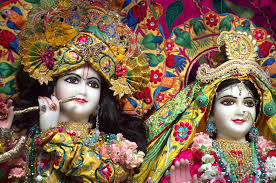
RadhaKrishna 2

While Krishna and Balaräma were passing in this way, They saw a washerman and dyer of clothing. Krishna was pleased to ask him for some nice clothing. He also promised that if the washerman would deliver the nicest dyed cloth to Him, the washerman would become very happy, and all good fortune would be his. Krishna was not a beggar, nor was He in need of clothing, but by this request He indicated that everyone should be ready to offer Krishna whatever He wants. That is the meaning of Krishna consciousness.
Unfortunately, this washerman was a servant of Kamsa and therefore could not appreciate the demand of Lord Krishna, the Supreme Personality of Godhead. This is the effect of bad association. He could have immediately delivered the clothing to the Supreme Personality of Godhead, who promised him all good fortune, but being a servant of Kamsa, the sinful demon could not accept the offer. Instead of being pleased, he was very angry and refused the Lord’s request, saying, ”How is it that You are asking for clothing which is meant for the King?” The washerman then began to instruct Krishna and Balaräma: ”My dear boys, in the future don’t be so impudent as to ask for things which belong to the King. Otherwise, You will be punished by the government men. They will arrest You and punish You, and You will be in difficulty. I have practical experience of this fact. Anyone who unlawfully wants to use the King’s property is very severely punished.”
On hearing this, Lord Krishna, the son of Devaki, became very angry at the washerman, and striking him with the upper portion of His hand, He separated the man’s head from his body. The washerman fell down dead on the ground. In this way Lord Krishna confirmed the statement of the Brahma-samhitä that every limb of His body is capable of doing everything He likes. Without a sword, but simply with His hand, He cut off the head of the washerman. This is proof that the Supreme Lord is omnipotent. If He wants to do something, He can do it without extraneous help.
After this ghastly incident, the employees of the washerman immediately dispersed, leaving the clothing. Krishna and Balaräma took possession of it and dressed according to Their choice; the rest of the clothes were offered to the cowherd boys, who also used them as they desired. What they did not use remained there. Krishna, Balaräma and the boys then proceeded along the main road. In the meantime, a devotee-tailor took the opportunity of service and prepared some nice clothes from the cloth for Krishna and Balaräma. Thus being very nicely attired, Krishna and Balaräma looked like elephants dressed with colored clothing on the full-moon day or the dark-moon day. Krishna was very much pleased with the tailor and gave him the benediction of särüpya-mukti, which means that after leaving his body he would be liberated and would attain a four-handed body exactly like that of Näräyana in the Vaikuntha planets. Krishna also granted him that as long as he would live he would earn sufficient opulence to be able to enjoy sense gratification. By this incident Krishna proved that those who are Krishna conscious devotees will not be lacking material enjoyment of sense gratification. They will have sufficient opportunity for such things, but after leaving this body they will be allowed to enter the spiritual planets of Vaikunthaloka or Krishnloka, Goloka Vrindävana.
After dressing nicely, Krishna and Balaräma went to a florist of the name Sudämä. As soon as They reached the precinct of his house, the florist immediately came out and with great devotion fell down on his face to offer his respectful obeisances. He offered a nice seat to Krishna and Balaräma and asked his assistant to bring out flowers, betel nuts and pulp of candana. The florist’s welcome greatly satisfied the Lord.
The florist very humbly and submissively offered his prayers to the Lord, saying, ”My dear Lord, because You have come to my place, I think all my forefathers and all my worshipable superiors are pleased and delivered. My dear Lord, You are the supreme cause of all causes of this cosmic manifestation, but for the benefit of the residents of this earthly planet, You have appeared with Your plenary portion to give protection to Your devotees and annihilate the demons. You are equally disposed as the friend of all living entities; You are the Supersoul, and You do not discriminate between friend and enemy. Yet You are pleased to give Your devotees the special result of their devotional activities. My Lord, I am praying that You please tell me whatever You wish me to do, because I am Your eternal servant. If You would order me to do something, it would be a great favor to me.” The florist, Sudämä, was greatly pleased within his heart by seeing Krishna and Balaräma in his place, and thus, as his choicest desire, he made two exquisite garlands of various flowers and presented them to the Lord. Krishna and Balaräma were very much pleased with his sincere service, and Krishna offered the florist His salutation and benedictions, which He is always prepared to bestow upon the surrendered souls. When the florist was offered benedictions, he begged from the Lord that he might remain His eternal servant in devotional service and by such service do good to all living creatures. By this, it is clear that a devotee of the Lord in Krishna consciousness should not be satisfied simply by his own advancement in devotional service; he must be willing to work for the welfare of all others. This example was followed by the Six Gosvämis of Vrindävana. It is therefore stated in a prayer about them, lokäntà hita-kärinau: Vaishnavas, or devotees of the Lord, are not selfish. Whatever benefits they derive from the Supreme Personality of Godhead as benedictions they want to distribute to all other persons. That is the greatest of all humanitarian activities. Being satisfied with the florist, Lord Krishna not only gave him whatever benedictions he wanted, but over and above that He offered him all material opulences, family prosperity, a long duration of life and whatever else his heart desired within the material world.


“Please distribute book, distribute book, distribute book.”


“These are the Bhägavata. There is no comparison. There is no literature throughout the universe like Srimad-Bhägavatam. There is no comparison. There is no competition. Every word is for the good of the human society. Every word, each and every word. Therefore we stress so much in the book distribution. Somehow or other, if the book goes in one’s hand, he will be benefited. At least he will see, “Oh, they have taken so much price. Let me see what is there.” If he reads one shloka, his life will be success. If he reads one Shloka, one word. This is such nice things. Therefore we are stressing so much, “Please distribute book, distribute book, distribute book.” A greater mridanga. We are chanting, playing our mridanga. It is heard within this room or little more. But this mridanga will go home to home, country to country, community to community, this mridanga.” 740105SB.LA


“Please distribute book, distribute book, distribute book.”

Posted in Uncategorized | Leave a comment

BGAII 2.17 P. The amazingly superficial expediency of JDS is to be strongly condemned!

In O(riginal) T(ranscript) Srila Prabhupada writes:

{Similarly in the Bhagavatam also the same version is stated as follows:

kesagra-sata-bhagasya shatamshah sadrishatmakah

jivah sukshma-svarupo’yam sankhyatito hi cit-kanah

There are innumerable particles of spiritual atoms, which are measured as one ten-thousandth part of the upper portion of hair.”}


In BGAII V1 Hayagriva with some faithfulness states:

{Similarly in the Bhagavatam the same version is stated:

kesagra-sata-bhagasya shatamshah sadrishatmakah

jivah sukshma-svarupo’yam sankhyatito hi cit-kanah

There are innumerable particles of spiritual atoms, which are measured as one ten-thousandth part of the upper portion of hair.”}

Hayagriva decides to drop “also” and “as follows”, even though there is no good reason to drop these two sequences of words.

But Jayadvaita’s amazingly superficial solution must be strongly condemned.

Realizing that the verse quoted is not one of the 18 000 original Srimad Bhagavatam verses, with his bird’s brain, he immediately condemns Srila Prabhupada’s statement as false and unceremoniously rearranges it as follows:

“Similarly the same version is stated.”

Not only is he offensive to his Guru, Srila Prabhupada, but he also disrespects the readers of Bhagavad-gita As It Is as well. He means: “Hey readers, if you really care to know where this verse comes from, find out by yourselves, cause I personally don’t care a fig, besides I am really far too busy falsifying the whole book. Thanks for believing me, guys, cause you are really making a big mistake. But I’ll keep running and misleading you as long as the running is easy.”

That is his ordinary rascal cheating mentality in action! Cheating because once more he has misrepresented Srila Prabhupada, the perfect and transcendental emissary of God, Krishna.

“The words spoken by the Lord are called apauruñeya, meaning that they are different from words spoken by a person of the mundane world who is infected with four defects. A mundaner (1) is sure to commit mistakes, (2) is invariably illusioned, (3) has the tendency to cheat others and (4) is limited by imperfect senses. With these four imperfections, one cannot deliver perfect information of all-pervading knowledge.” BGAII Introduction.

I add the text of my reply to Dravida Prabhu on this subject matter dated July 1st 2020:

“Thank you very much for your quick response, Dravida Prabhu.

1 ) As a worker on the Vedic scriptures, the amazingly superficial expediency of JDS is to be strongly condemned, yes!!!

2 ) We all agree that this verse does not seem to part of the original 18000 of the SB.

3 ) To reference  CC M19.140 instead, was my first thought and is indeed a minimum requirement.

4) But how many commentaries to the SB did Srila Prabhupada write? Many thousands, is it not!

Almost one for each verse up to canto 10. This does represent thousands indeed!

  We routinely refer to them as the SB.

In that sense, SB commentaries are not different from SB

 Therefore Srila Prabhupada is right as in 99 % of the cases

His OT rendition should be left alone.

Jai Srila Prabhupada!

And thank you very much for your attention!”

Posted in Uncategorized | Leave a comment