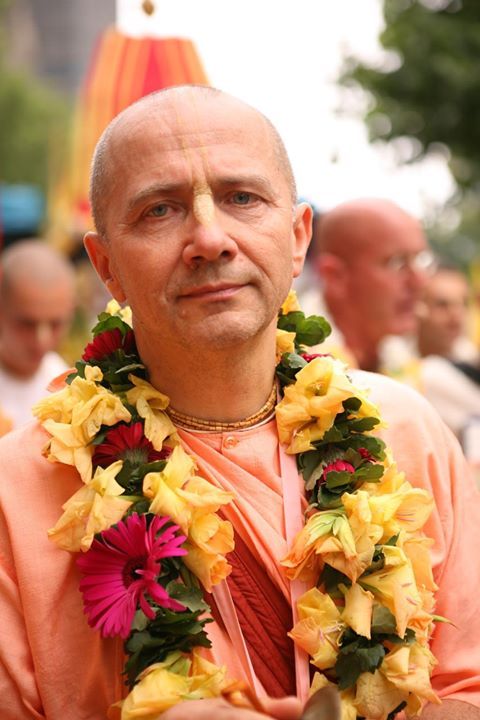
About chanting the Hare Krishna Maha Mantra. Hare Krishna Hare Krishna Krishna Krishna Hare Hare Hare Rama Hare Rama Rama Rama Hare Hare

This chanting of the Hare Krishna Maha Mantra is such a nice thing!


HARE KRISHNA HARE KRISHNA

KRISHNA KRISHNA HARE HARE

HARE RAMA HARE RAMA

RAMA RAMA HARE HARE

Imagine your boss gives you every day two paid hours, where all you have to do is to chant


HARE KRISHNA HARE KRISHNA

KRISHNA KRISHNA HARE HARE

HARE RAMA HARE RAMA

RAMA RAMA HARE HARE


You can forget all your worries, be peaceful in your mind, no one is allowed to bother you with anything. Just be cozy with Krishna. And Krishna is not different from His name. Does that not sound wonderful? Maybe it should become a Union claim. It would have to be a claim of the Krishna Union. It is our claim. Please chant two hours of Hare Krishna Maha Mantra every day and just see what will happen in your life! This is self-development. This is self-realization.

To get best results, of course, one also has to follow the four regulative principles of yoga discipline.

1 ) No illicit sex. Sex is allowed, but illicit sex is not allowed.

2 ) No gambling

3 ) No intoxication, including cigarettes, coffee and tea

4 ) no eating of meat, fish or eggs

Seriously, in these dangerous times, two hours of daily peace and tranquility represent a real asset in life. Why not take advantage of the opportunity? When I go on preaching tour, I find that one of the greatest assets of the Australian people is their absolute courtesy. It is really a delight to deal with them, even though our personal views and philosophies may differ. That is just astounding! And when I ask them to please chant the Maha Mantra Hare Krishna they mostly comply. I lead them through the chanting half after half.  The other day at Bunnings, when I asked him to chant, the young gentleman mentioned that he came in contact with Hare Krishna previously in school. He did not at all hesitate to chant. Others mention “My sweet Lord” by George Harrison. Sometimes it is played on the radio, just on the right time.  The CUA lady chanted Hare Krishna Maha Mantra on the phone. And the ANZ phone employee mostly visit the Hare Krishna temple in Melbourne, Albert Park.

There is an important shastra passage in this respect:

Madhya 7.102

TEXT

yäre dekhe, täre kahe,—kaha krishna-näma
ei-mata ’vaishnava’ kaila saba nija-gräma

WORD FOR WORD RENDITION

yäre dekhe—whomever he meets; täre—to him; kahe—he says; kaha krishna-näma—kindly chant the Hare Krishna mantra; ei-mata—in this way; vaishnava—devotees of the Supreme Personality of Godhead; kaila—made; saba—all; nija-gräma—his own village.

TRANSLATION

Such an empowered person would request everyone and anyone—whomever he saw—to chant the holy name of Krishna. In this way, all the villagers would also become devotees of the Supreme Personality of Godhead.

PURPORT

In order to become an empowered preacher, one must be favored by Lord Sri Caitanya Mahäprabhu or His devotee, the spiritual master. One must also request everyone to chant the mahä-mantra. In this way, such a person can convert others to Vaishnavism, showing them how to become pure devotees of the Supreme Personality of Godhead.

My point is that Australian society is already saturated with Hare Krishna. If we keep on saturating it more and more with Hare Krishna, at some point there will be a Hare Krishna explosion, as there was Hare Krishna explosion in USA in the seventies under the incentive of Srila Prabhupada. Better be present and ready to take part in the Australian Hare Krishna explosion fun.

Posted in Uncategorized | Leave a comment

The main editor’s NASTY and CRAZY HABITS. Bhagavad-gita As It Is 2.24, 7.2, 16.7 and many others, including change of name of chapter six of Bhagavad-gita As It Is from the original Sankhya-yoga to the current Dhyana-yoga. Please do not mess with Srila Prabhupada in such a whimsical and unauthorized fashion!

JAYADVAITA SWAMI, AN ISKCON SANNYASI AND US CITIZEN, THE OFFICIAL FALSIFIER OF THE FOUNDER-ACARYA’S, SRILA PRABHUPADA’S MESSAGE, ESPECIALLY BHAGAVAD-GITA AS IT IS.

FALSIFYING is a  CRIMINAL ACTIVITY IN MOST, IF NOT ALL CASES. It is an ILLEGAL ACTIVITY IN ALL CASES.

BGAII 2.24 V1

This individual soul is unbreakable and insoluble, and can be neither burned nor dried. He is everlasting, all pervading, unchangeable, immovable and eternally the same.

BGAII 2.24 V2

This individual soul is unbreakable and insoluble, and can be neither burned nor dried. He is everlasting, present everywhere, unchangeable, immovable and eternally the same.


BGAII 2.24 OT (Late discovery and addition on June 22, 2020) You draw the conclusion.

This individual soul is unbreakable, cannot be burnt, insoluble, nondriable, everlasting, present everywhere, non changeable, immovable and eternally the same. 


It may be argued here that there should be no coma after “insoluble” and that “all pervading'” should be written as “all-pervading”, as Grammarly suggests.

Even though important considerations, these are not the real issues here.

The real issue is of a different nature.

The real issue is the freedom that the editor has taken in replacing the word “all-pervading” with the expression “present everywhere.”

This is the real issue!

Both editions agree in the word for word AND in the purport that the rendition of “sarva-gatah” is to be “all-pervading”. But these are not enough arguments for this eccentric editor, who still takes the false freedom to replace “all-pervading” of version 1 with “present everywhere” in the actual rendition of the verse in version two.

The same applies to BGAII 7.2, where the super-and over-intelligent man, in his otherworldly ecstasy and superiority complex and against all conventions replaced “noumenal” with “numinous.” Actually, there is no proof either way of what Srila Pabhupada actually said, as Srila Pabhupada’s systematic policy was erase-and-re-use the tapes. However, His Divine Grace Srila Bhaktisiddhanta Sarasvati Goswami Thakura, our param Guru, uses the expression “phenomenal and noumenic” in page xxi of Foreword of his presentation of Sri Brahma-Samhita. The difference between “noumenal” and “noumenic” is insignificant et perhaps historic only.

But the editor knows better than even the Acaryas themselves and he is most attached to his concoction. I believe in the Caitanya Caritamrta this attitude is described as cause for total rejection. One immediately becomes fallen in such case.

What a sick mind!

What a nuisance!

Quel enquiquineur!

What a dissonance in the orchestra!

Such an editor can NEVER be fully trusted.

He is banned from interfering with the Founder-Acarya’s, Srila Prabhupada’s works altogether!

Sometimes in 1972 or before, Srila Prabhupada ostensibly declared to Pradyumna Prabhu (ACBSPgen1) that one single mistake murders the whole book.

What to speak of three intentional “mistakes”?

What to speak of hundreds of mistakes?

This editor is definitely the one whose crazy interpretations have killed the spirit of Bhagavad-gita As It Is. These are only two examples among many others.

And why doesn’t he have the courage to put his name to it? I see “Second Edition. Revised and Enlarged”. But I do not see anywhere the mention ” by His Holiness Jayadvaita Swami.” He prefers to do it on the sly obviously, like a perfect vaishya.

This conceited individual clearly considers himself the exclusive anointed master of all changes in Srila Prabhupada’s books and as a consequence, he does not cease to overstep his mandate and totally ignores good advice. And other ill-advised persons support him. He is accepted as respectable Vedic scholar, but I am saying he is NONSENSE NUMBER ONE and should be stopped in his tracks without any further delay. And unless he gets very severely insulted, he will definitely not listen or pay attention. Whence this article and more to come, an ungrateful job indeed.

Bhagavad-gita As It Is is NOT a treatise of liturgy, as this editor would like to have it!

Bhagavad-gita As It Is is a philosophical treatise of the highest order.

Moreover, Srila Prabhupada meant it to be a bona fide version “AS IT IS”, true to the original, as if we were reading the text in Sanskrit. This editor has corrupted Srila Prabhupada’s intention!

In other words, the current presentation of  Bhagavad-gita by His Divine Grace A.C. Bhaktivedanta Swami Prabhupada CANNOT be rightly called Bhagavad-gita As It Is. In all honesty and accuracy, it should be called instead Bhagavad-gita as seen by HH Jayadvaita Swami. Restoring Bhagavad-gita As It Is by His Divine Grace A.C Bhaktivedanta Swami Prabhupada is, therefore, a task of the highest degree of urgency. It is an entirely different book.

Besides that, he is clearly a dishonest individual. Now that he has done his mischief, of which he is very well aware and is unrepentant of, he is hiding under the guise of retirement. But we all know there is no such thing as retirement in Krishna consciousness. All the elderly members of the family, including Bhisma and Dronacarya, came to the battlefield of Kuruksetra ready to fight and meet their fate, in the presence of Sri Krishna, the Supreme Personality of Godhead.

In His magnanimity, Srila Prabhupada may have once trusted this individual, as He has done with so many others, who have subsequently let Him down and betrayed Him. Everyone gets his chance in Krishna consciousness. And the rest is up to him.

Finally, I need absolutely to underline a third muddled passage of the current presentation of the Bhagavad-gita As It Is. This is of the utmost gravity and severe influential consequences, as it concerns proper and improper action. I am referring to BGAII 16.7. This muddle was not at all present in version one and we may therefore conclude safely that again it is the creation of Swami Jayadvaita.

The verse itself is the same for both versions as follows:

“Those who are demoniac do not know what is to be done and what is not to be done. Neither cleanliness nor proper behavior nor truth is found in them.”

(And why are there no additional comas in the last sentence of verse 16.7 of BGAII?)

The problems lie with the change the editor has introduced to the word for word rendition.

BGAII V1 word for word (partial)

pravrittim-proper action; ca-also; nivrittim-improper action etc…..

BGAII V2 word for word (partial)

pravrittim-acting properly; ca-also; nivrittim-not acting improperly etc….

This truly represents a wicked way to twist Srila Prabhupada’s words and intentions! In Srila Prabhupada’s own terms, this is truly rascaldom!

Any sane person will easily understand that “acting properly” equals “not acting improperly.”

And if “pravritim” and “nivrittim” are sanskrit synonyms,  the inference is that actually there is no such thing as proper action and improper action and that all is one.

The result of such a proposal will be demoniac chaos, which te demoniac Jayadvaita Swami seems to promote here.

The final conclusion will have to be that Mr. Jayadvaita Swami, born Jay Israel to a Reform Jewish family on November 2nd 1949 in Englewood, New Jersey, USA  (sourced from Wikipedia) is not only a hypocrite but also a pretender, an imposter and a cheater, as he poses himself as a pure servant of God, Krishna, which he is not.

Please find purport of verse 7 of chapter 3 of Bhagavad-gita As It Is, titled “Karma-yoga.” to illustrate my point.

“Instead of becoming a pseudo transcendentalist for the sake of wanton living and sense enjoyment, it is far better to remain in one’s own business and execute the purpose of life, which is to get free from material bondage and enter into the kingdom of God. The prime svärtha-gati, or goal of self-interest, is to reach Vishnu. The whole institution of varna and äshrama is designed to help us reach this goal of life. A householder can also reach this destination by regulated service in Krishna consciousness. For self-realization, one can live a controlled life, as prescribed in the shästras, and continue carrying out his business without attachment, and in that way make progress. A sincere person who follows this method is far better situated than the false pretender who adopts show-bottle spiritualism to cheat the innocent public. A sincere sweeper in the street is far better than the charlatan meditator who meditates only for the sake of making a living.”


Posted in Uncategorized | Leave a comment

Krishna consciousness, or God consciousness, the most wonderful and perfect philosophy of TRANSCENDENTAL Equalitarianism! ‬

Subtitle.

Sexism, sexism, sexism and more sexism.

In an attempt to gather a consensus on the definition of the word “Equalitarianism” let us first of all quote Wikipeadia.

Egalitarianism (from French égal, meaning ‘equal’), or equalitarianism,[1][2] is a school of thought within political philosophy that prioritizes equality for all people.[3] Egalitarian doctrines are generally characterized by the idea that all humans are equal in fundamental worth or moral status.[4] Egalitarianism is the doctrine that all citizens of a state should be accorded exactly equal rights.[5]

According to the Merriam-Webster Dictionary, the term has two distinct definitions in modern English,[6] namely either as a political doctrine that all people should be treated as equals and have the same political, economic, social and civil rights,[7] or as a social philosophy advocating the removal of economic inequalities among people, economic egalitarianism, or the decentralization of power. Some sources define egalitarianism as the point of view that equality reflects the natural state of humanity.”

Of course, from a Krishna conscious point of view, we must immediately point out that this is not really equaliterianism. This is a false definition, because it is based on a poor fund of knowledge. It is in fact imperialism, because it clearly excludes non-humans. True equalitairianism includes all living beings, such as animal and plants etc..

For the purpose of our article, it is however useful.

We are not these bodies. All living things are spirit souls, part and parcels of God, Krishna. Therefore they are fundamentally equal.

Bhagavad-gita As It Is, 5.18.

TRANSLITERATION OF THE SANSKRIT.

vidyä-vinaya-sampanne

brähmane gavi hastini

shuni caiva shva-päke ca

panditäh sama-darshinah

WORD FOR WORD TRANSLATION

vidyä—with education; vinaya—and gentleness; sampanne—fully equipped; brähmane—in the brähmaëa; gavi—in the cow; hastini—in the elephant; shuni—in the dog; ca—and; eva—certainly; shva—päke—in the dog—eater (the outcaste); ca—respectively; panditäh—those who are wise; sama-darshinah—who see with equal vision.

TRANSLATION

The humble sages, by virtue of true knowledge, see with equal vision a learned and gentle brähmana, a cow, an elephant, a dog and a dog-eater [outcaste].

What is the meaning of “transcendental”?

Transcendental means beyond the three modes of material nature, tama guna, raja guna and sattva guna.

In Bhagavad-gita As It Is, 2.45, Sri Krishna, the Supreme Personality of Godhead, exhorts His friend Arjuna as follows:

TRANSLITERATION OF THE SANSKRIT

trai-gunya-vishayä vedä

nistrai-gunyo bhavärjuna

nirdvandvo nitya-sattva-stho

niryoga-kshema ätmavän

WORD FOR WORD TRANSLATION

trai-gunya—pertaining to the three modes of material nature; vishayäh—on the subject matter; vedäh—Vedic literatures; nistrai-gunyah—transcendental to the three modes of material nature; bhava—be; arjuna—O Arjuna; nirdvandvah—without duality; nitya-sattva-sthah—in a pure state of spiritual existence; niryoga-kshemah—free from ideas of gain and protection; ätma-vän—established in the self.

TRANSLATION

The Vedas deal mainly with the subject of the three modes of material nature. O Arjuna, become transcendental to these three modes. Be free from all dualities and from all anxieties for gain and safety, and be established in the self.

The three modes of material nature are specifically explained in chapter 14 of the Bhagavad-Gita As It Is. This chapter itself is called “The Three Modes of Material Nature.” We invite our readers to carefully study chapter 14 of Bhagavad-gita As It Is, as this concept of the three modes of material nature or the “gunas”, as well as their supervisors, the three guna-avataras, Lord Vishnu, Lord Brahma and Lord Shiva, are conspicuous by their absence in western philosophy. This is not at all astonishing as western man-made philosophy is completely under the dictation of the three modes of material nature. How can a night owl describe the sun? Whereas Bhagavad-gita As It Is has a transcendental source.

The three modes of material nature constantly struggle amongst themselves for supremacy :

BGAII 14.10

Sometimes the mode of goodness becomes prominent, defeating the modes of passion and ignorance, O son of Bharata. Sometimes the mode of passion defeats goodness and ignorance, and at other times ignorance defeats goodness and passion. In this way, there is always competition for supremacy.

The influence of the three modes of nature is all-pervading as, explained in Bhagavad-gita As It Is 18.40:

“There is no being existing, either here or among the demigods in the higher planetary systems, which is freed from these three modes born of material nature.”

Whereas the position of one who has overcome the three modes of nature is very much enviable, as described in Bhagavad-gita As it is 14.26:

One who engages in full devotional service, unfailing in all circumstances, at once transcends the modes of material nature and thus comes to the level of Brahman.

Now to our subtitle: Sexism, sexism, sexism, and more sexism.

Because it originates from the greatest, Sri Krishna, the Supreme Personality of Godhead, Krishna consciousness is the greatest philosophy. There is no doubt about it. In Bhagavad-gita AsIt Is 15.18, Sri Krishna confirms that He is the greatest: “Because I am transcendental, beyond both the fallible and the infallible, and because I am the greatest, I am celebrated both in the world and in the Vedas as that Supreme Person.” The famous boxer may say he is the greatest. And that may be true in a relative sense. But Sri Krishna will knock him out in just a few seconds if it were to come to that, as He has amply proven in His activities (karma) described in the Krishna Book by His Divine Grace A.C. Bhaktivedanta Swami Prabhupada.
When improperly practiced and improperly understood Krishna consciousness can lead, like most other things in life, to great abuses as well. This is especially true in our attitude towards women. According to Canakya Pandit, the great Indian philosopher cum politician, all women except one’ s own wife, are to be considered and respected as mothers. He specifically says:

Mätrivat para-däreshu para-dravyeshu lostravat,

ätmavat sarva-bhüteshu yah pashyati sa panditah

He is the learned man who sees all women (except one’s own wife) as his mother, other’s property should be accepted just like refused garbage in the street and treat every living entity as he would like to be treated himself.

In 660803BG.NY, Srila Prabhupada explains the matter very nicely and twice he underlines that education is not at all a matter of university degrees of which contemporary ISKCON has become so proud of, another deviation and betrayal of Srila Prabhupada:

“Pandita. This pandita. This pandita, explanation of panditita. Now, who is a pandita? Now, mätrivat para-däreshu: “He is the learned man who sees all women as his mother.” Except one’s married wife, one should see every woman as his mother. Mätrivat. Mätå means mother. Vat means just like. Mätrivat para-däreshu. Para-däreshu means other women except one’s own wife, married wife.
Mätrivat para-däreshu para-dravyeshu loshtravat: “And other’s property should be accepted just like refused garbage in the street.” Just like we don’t care for all the garbages. Simply if others’ money or others’ property is there, sometimes we hanker, we should think, “Oh, these are nonsense, just like garbage.” Mätrivat para-däreshu para-dravyeshu loshtravat, ätmavat sarva-bhüteshu. And loshtra means that rubbles, just like stone rubbles. You see? There are so many rubbles and, er, strewn over the street. Nobody cares for that. Similarly, if others’ money is thrown over the street, nobody… He should not care. He should not collect: “Oh, here is some money. Let me take.”
So mätrivat para-däreshu para-dravyeshu loshtravat, ätmavat sarva-bhüteñu. And he should see everyone… This ätmavat sarva-bhüteshu was preached by Lord Buddha, this philosophy. This one philosophy was, I mean to say, taught throughout the whole world by Lord Buddha, that there should be no animal killing. Ätmavat sarva-bhüteshu. No living entity should be given suffer, even by words. That is real life. Ätmavat… Yah pashyati. One who has such vision of life, he is called learned. He is called learned—not by educational qualifications. One who has acquired… Phalena pariciyate. Education is understood, how far a man is educated, by his behavior. By his vision of life it will be estimated, not by the degrees. Ätmavat sarva-bhüteshu yah pashyati sa panditah.”

Women are not at all to be considered as sisters, as some speculate. Even less to be considered as sex objects or sex slaves as some wicked men would want to have it. They are to be respected as mothers. Mother holds a respected, a very functional and perhaps a commanding position in the family. Mother is very important. She holds a nurturing role. In most cases, it is therefore possible to have an affectionate relationship with mother.

“According to scriptures, there are seven mothers: (1) the real mother, (2) the wife of the spiritual master, (3) the wife of a brähmana, (4) the wife of the king, (ruler) (5) the cow, (6) the nurse, and (7) the earth. All of them are mothers.” SB 1.11.28

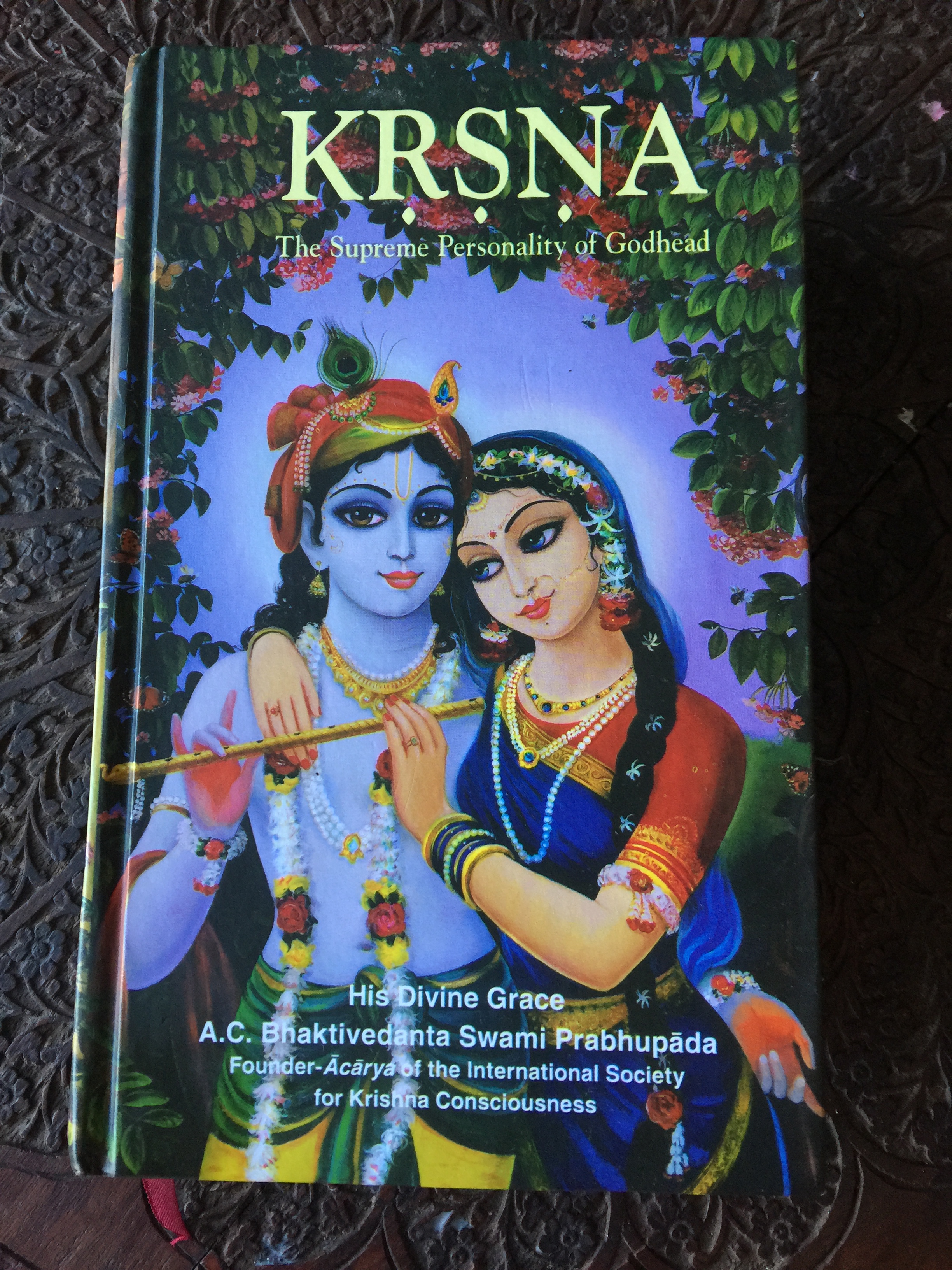
And here we have two paintings of the relationship between Radha and Krishna


These two paintings have both been used by the Bhaktivedanta Book Trust as the covers for Srila Prabhupada’s Krishna Book. It may be objected that the second picture is flagrantly sexist in its representation of the transcendental relationship between Radha and Krishna and by extension in its representation of romantic relationships.

Sexism or misogyny comes this time from the Bhaktivedanta Book Trust, Srila Prabhupada’s publishing company and parallel to but an independent company of ISKCON. Of course, the term “sexism” includes “misogyny”, whereas the opposite is not true, as sexism, or discrimination on the basis of gender, can go both ways.

The first picture is very sweet. The colors and forms are nice. The style of painting is very nice. I was otherwise wondering whether this very pleasant style of painting has got a particular name like other styles are called renaissance or surrealism.  It depicts a relationship amongst equals, full of transcendental familiarity and transcendental affection. According to shastra, this is the Vrindavan mood. Such divine friendliness is confirmed in Caitanya Caritamrita, Antya 7.29. But just the other way round. Sri Caitanya Mahaprabhu, the Supreme Personality of Godhead Himself is speaking:

“When Lord Sri Krishna was dancing with the gopis in the räsa-lilä, the gopis were embraced around the neck by the Lord’s arms. This transcendental favor was never bestowed upon the goddess of fortune or the other consorts in the spiritual world. Nor was such a thing ever imagined by the most beautiful girls in the heavenly planets, girls whose bodily luster and aroma resemble the beauty and fragrance of lotus flowers. And what to speak of worldly women, who may be very, very beautiful according to material estimation?”

The second picture is not at all the Vrindavan mood, where this relationship is supposed to be developing. We see a very domineering male and a very insignificant and sheepish female pushed in the right hand lower side of the cover. Is this a predator wolf in the guise of a flute player about to attack an innocent woman? I let the imagination and good sense of my readers draw the appropriate conclusions.

The good news is that the next print of minimum 100.000 copies of Srila Prabhupada’s Krishna Book will have the wonderful first picture on the cover. Please make sure to secure your personal copy. This is truly fascinating and educational reading!

I suppose we all make mistakes. Hare Krishna


Posted in Uncategorized | Leave a comment

Recommended route description for transcendental travel. CC M 19.153 & 19.154

As one waters the bhakti-latä-bija, the seed sprouts, and the creeper gradually grows to the point where it penetrates the walls of this universe and goes beyond the Virajä River, lying between the spiritual world and the material world. It attains brahma-loka, the Brahman effulgence, and penetrating through that stratum, it reaches the spiritual sky and the spiritual planet Goloka Vrindävana. CC M 19.153

”Being situated in one’s heart and being watered by shravana-kirtana, the bhakti creeper grows more and more. In this way it attains the shelter of the desire tree of the lotus feet of Krishna, who is eternally situated in the planet known as Goloka Vrndävana, in the topmost region of the spiritual sky. CC M 19.154

Further more in the purport of text 154, last paragraph, we find a wealth of transcendental information:

“Goloka Vrindävana is the highest planet in the spiritual world. In order to go to the spiritual world after penetrating the covering of the material universe, one must penetrate Brahma-loka, the spiritual effulgence. Then one can come to the Goloka Vrindävana planet. There are also other planets in the spiritual world, called Vaikuntha planets, and on these planets Lord Näräyaëa is worshiped with awe and veneration. On these planets shänta-rasa is prevalent, and some of the devotees are also connected with the Supreme Personality of Godhead in däsya-rasa, the mellow of servitorship. As far as the mellow of fraternity is concerned, in Vaikuntha this rasa is represented by gaurava-sakhya, friendship in awe and veneration. The other fraternity rasa, exhibited as vishrambha (friendship in equality), is found in the Goloka Vrindävana planet. Above that is service to the Lord in vätsalya-rasa (parental love), and above all is the relationship with the Lord in the mädhurya-rasa (conjugal love). These five rasas are fully exhibited in the spiritual world in one’s relationship with the Lord. Therefore in the spiritual world the bhakti creeper finds its resting place at the lotus feet of Krishna.”

COMMENTARY.

First of all, we note that the word “brahma-loka” presents two meanings.

1 ) The residence of Lord Brahma, the engineer of the universe. This is a material planet within the walls of the universe. It is in fact, the topmost planet of the universe.

2) Brahmajyoti and Brahma-loka are synonyms and refers to the spiritual effulgence of the transcendental body of Lord Krishna. Not only is this particular Brahma-loka situated in the spiritual world, but it represents an integral part of the spiritual world itself. Which is basically saying the same thing, as all things in the spiritual world are made of the same transcendental stuff, whose characteristics are well opposed to that of matter, as we perceive it with our gross senses.

From this passage we gather also the information that some devotees of the Lord on the Vaikuntha planets are related to the Lord through the shanta-rasa, the neutrality relationship. Not just some devotees but the majority, as Srila Prabhupada writes that this shanta-rasa is prevalent in the Vaikunthas. That’s very interesting, as my conception of Shanta rasa in this material world was for example, the relationship with the chair I am sitting on. In other words, my relationship with an inanimate object. However here it is clearly stated that the devotees of Vaikuntha enjoy the shanta-rasa with Krishna.

Another interesting point in this paragraph, is that there are two kinds of sakhya-rasa and they are, from the lower to the higher:

Gaurava-sakhya, friendship in awe and veneration found in the Vaikuntha planets

and

vishrambha-sakhya, friendship in equality found exclusively in Goloka Vrindavan. The same distinction applies to madhurya-rasa (conjugal love) also called sringara-rasa. The queens of Vaikuntha do not enjoy the same degree of familiarity with Krishna, as the cowherd girls of Vrindavana do.

What an achievement for a transcendental traveler to become a real friend of the Supreme Personality of Godhead, the master of all worlds! The kind of friendship that is not at all imbued with awe and veneration, but allows one to go cow herding every day with the Supreme Personality of Godhead in Vrindavan, share meals with Him, joke with him, and play games like for example climbing on His back for couple wrestling. We sometimes see this type of activity happening on the beaches just for fun. These activities are vividly described in Srila Prabhupada’s Krishna book. The cow herding in the company of Krishna is boys-only activity. Even though we hear of the existence of the cowherd girls, we don’t hear that they accompany the boys for this activity. That does not mean at all that girls have less access to the Supreme Personality of Godhead. They have full access, but in a different rasa. And Krishna, being the Supreme Personality of Godhead can manage simultaneously zillions of zillions of relationships. And He does so right now! In that realm, there are consequently no problems at all.

We also learn that Krishna’s planet, Goloka Vrindavan is the topmost of all planets. How about a whole planet to establish one’s exclusive residence? We hear that some rich and influential people purchase a whole island for their residence, others purchase properties of hundreds of thousands and even millions of hectares. But a whole planet? Another display of Krishna unrivaled opulence!  And there you will find desire trees and surabhi cows and other unimaginable marvels. as per Brahma-Samhita 5.29

TEXT 29

cintämani-prakara-sadmasu kalpa-vriksha-
lakshävriteshu surabhir abhipälayantam
lakshmé-sahasra-shata-sambhrama-sevyamänam
govindam ädi-purusham tam aham bhajämi

SYNONYMS

cintämani—touchstone; prakara—groups made of; sadmasu—in abodes; kalpa-vriksha—of desire trees; laksha—by millions; ävriteñu—surrounded; surabhih—surabhi cows; abhipälayantam—tending; lakshmi—of goddesses of fortune; sahasra—of thousands; shata—by hundreds; sambhrama—with great respect; sevyamänam—being served; govindam—Govinda; ädi-purusham—the original person; tam—Him; aham—I; bhajämi—worship.

TRANSLATION

I worship Govinda, the primeval Lord, the first progenitor who is tending the cows, yielding all desire, in abodes built with spiritual gems, surrounded by millions of purpose trees, always served with great reverence and affection by hundreds of thousands of laksmis or gopis. All rights reserved to BBT International and the author of the article.


Here again, (CC M 19.153 purport, last paragraph. ) Srila Prabhupada uses two times the word “mellow” as a noun. This is rather an unconventional use of the word “mellow”, because the english dictionary gives “mellow” as an adjective and as well as a verb, but the English dictionary does not give “mellow” as a noun. At least in this passage, Srila Prabhupada basically uses interchangeably three different words i.e. relationship, mellow and rasa to designate the same phenomenon. Two of these words are English and one is a Sanskrit word. Out of the two English terms, the word “mellow” is used in a unique and exclusive Prabhupada-way.

Another parampara way to call this is the Hare Krishna style or Hare Krishna way, as Srila Prabhupada Himself confirms in 700109let.Satsvarupa. On my website www.krishnaculture.org, one will find the seed of a Prabhupada glossary as well. All glories to Srila Prabhupada!

The word “mellow” is used 908 times in the Vedabase.

Srila Prabhupada therefore, makes here a personal and unconventional use of the word. In the beginning it may conflict with our sense of the use of the English language. But we can adopt this Prabhupada-way relatively easily. And why “mellow” should not be used as a noun? Conventionally, it is already used as a verb and as adjective and Srila Prabhupada in His own perfection and completeness, complements even the English language by using “mellow” as a noun. After all the English language, especially in its rules of pronunciation is quite a whimsical affair, as Srila Prabhupada has often pointed out. For example, even though the u spelling is the same, the words “put” and “but” call for a different sound in their pronunciations. According to Srila Prabhupada, such variations are clearly whimsical and do not exist in the Sanskrit language,. Of course the English noun directly associated with “mellow” is “mellowness.” says my World Book Dictionary. 1975 edition, printed in USA. ISBN 0-7166-0275-X. It says also these words are related to mild. And in the explanation of the adjective “mellow” the following words appear: soft, full-flavored, ripe, sweet, juicy, mature, rich. In relation to a person we find the following explanation: softened and made wise by age and experience; having the gentleness or dignity resulting for maturity.

It is therefore no wonder that “mellow” was rightly chosen, because it conveys the intended meaning perfectly and completely and because rasa is, after all, the reservoir of all pleasure. Which brings us to the real point, as HG Dravida Prabhu has just reminded me that His Divine Grace Bhaktisiddhanta Sarasvati Goswami Thakur, Srila Prabhupada’s spiritual master and our param Guru, is the actual initiator of this practice.

In the book Brahma Samhita by our param Guru, the words “mellow” is used 5 times. In Brahma-samhita 5.3, it is clearly suggested that “mellow” is the English equivalent for the Sanskrit “rasa”. The other four times, “mellow” is used conventionally as an adjective.


Posted in Uncategorized | Leave a comment

Message from the rotating and current chairperson of The International Society for Krishna consciousness, His Holiness Ramai Swami.

Posted in Uncategorized | Leave a comment

CHANT THE HOLY NAMES OF GOD TO FIGHT CORONA VIRUS.

Dear Devotees, PAMHO.  AGTSP.
ISKCON Harinam Sankirtan Ministry is happy to announce:
GLOBAL NON STOP YAJNA from Your Home!
Let’s join hands, mrdangas and kartalas.  Everyday, in each respective time zone for 1 month. This means that in some part of the world, at any given time, chanting is going on.
Daily 5 pm to 5:15 pm (Minimum.  More is welcome).
March 25 – April 25, 2020
We humbly appeal to everyone to go out on your terrace, courtyard, rooftop or webcam and perform KIRTAN! WORLDWIDE!
Your simple Like & Share will be a priceless contribution to saving humanity from the crisis.
Promote this event in your area:
GLOBAL NON-STOP SANKIRTAN YAJNA
Thank you for your kind understanding, cooperation and participation.
Your servant,
Lokanath Swami
ISKCON Harinam Sankirtan Minister
P.S. Please send your photos, videos and reports to:
#iskconsankirtan #gocorona #covid19 #waragainstvirus
___________________________________________________________________
Please CHANT the names of God as in
HARE KRISHNA HARE KRISHNA
KRISHNA KRISHNA HARE HARE
HARE RAMA HARE RAMA
RAMA RAMA HARE HARE
This mantra has specifically been designed by the sages of the Holy Land of India and is therefore especially powerful in the current fallen age of Kali.
But “The second offense is to see the holy names of the Lord in terms of worldly distinction. The Lord is the proprietor of all the universes, and therefore He may be known in different places by different names, but that does not in any way qualify the fullness of the Lord. Any nomenclature which is meant for the Supreme Lord is as holy as the others because they are all meant for the Lord. Such holy names are as powerful as the Lord, and there is no bar for anyone in any part of the creation to chant and glorify the Lord by the particular name of the Lord as it is locally understood. They are all auspicious, and one should not distinguish such names of the Lord as material commodities. ” Srimad Bhagavatam 2.1.11 purport.
In other words, any name of God is alright. Important thing is to
CHANT, CHANT, CHANT.
There is an anecdote in this regard:
“Srila Prabhupäda sometimes referred to a magazine cartoon that depicted an old man and an old woman sitting across from each other; the wife was telling the husband, “Chant, chant, chant,” and the husband was replying, “Can’t, can’t, can’t.” This is our misfortune, our stubborn refusal, or reluctance, to chant. With the same effort it took the husband to refuse to chant, Srila Prabhupäda noted, he could have chanted.”
Life’s Final Exam, Introduction, by HH Giriraja Swami
and also the same instance from a different perspective:
“There is a cartoon picture in New York, one old man and his wife, sitting together. The wife is requesting the husband, old husband, “Chant, chant, chant,” and the husband is replying, “Can’t, can’t, can’t.” [laughter] This cartoon we have seen. So this is the… He will say three times, “Can’t, can’t, can’t,” but not “Krishna, Krishna, Krishna.” That is not possible. A similar story is there in the Bengal. One old mother was dying, and the sons requested the mother, “Mother, now you say ‘Hare Krishna Hare Krishna.’ ” So after requesting two, three times, mother became disgusted: atha katha nivalta nare.[?] So atha katha nivalta nare[?] she could say. Not Hare Krishna. Not Hare Krishna. This is the position.” 730629BG.Kol
Posted in Uncategorized | Leave a comment

Some technical information for yogis, especially hatha-yogis from Bhagavad-gita As It Is 2.17 by His Divine Grace A. C. Bhaktivedanta Swami Prabhupada.


SANSKRIT TRANSLITERATION

avinäshi tu tad viddhi
yena sarvam idam tatam
vinäsham avyayasyäsya
na kashcit kartum arhati

WORD FOR WORD TRANSLATION

avinäshi—imperishable; tu—but; tat—that; viddhi—know it; yena—by whom; sarvam—all of the body; idam—this; tatam—pervaded; vinäsham—destruction; avyayasya—of the imperishable; asya—of it; na kashcit—no one; kartum—to do; arhati—is able.

TRANSLATION

That which pervades the entire body you should know to be indestructible. No one is able to destroy that imperishable soul.

PURPORT

This verse more clearly explains the real nature of the soul, which is spread all over the body. Anyone can understand what is spread all over the body: it is consciousness. Everyone is conscious of the pains and pleasures of the body in part or as a whole. This spreading of consciousness is limited within one’s own body. The pains and pleasures of one body are unknown to another. Therefore, each and every body is the embodiment of an individual soul, and the symptom of the soul’s presence is perceived as individual consciousness. This soul is described as one ten-thousandth part of the upper portion of the hair point in size. The Shvetäshvatara Upanishad (5.9) confirms this:

bälägra-shata-bhägasya
shatadhä kalpitasya ca
bhägo jivah sa vijneyah
sa cänantyäya kalpate

“When the upper point of a hair is divided into one hundred parts and again each of such parts is further divided into one hundred parts, each such part is the measurement of the dimension of the spirit soul.” Similarly the same version is stated:

keshägra-shata-bhägasya
shatämshah sädrishätmakah
jivah sükshma-svarüpo ‘yam
sankhyätito hi cit-kanah
[Cc. Madhya 19.140]

“There are innumerable particles of spiritual atoms, which are measured as one ten-thousandth of the upper portion of the hair.”

Therefore, the individual particle of spirit soul is a spiritual atom smaller than the material atoms, and such atoms are innumerable. This very small spiritual spark is the basic principle of the material body, and the influence of such a spiritual spark is spread all over the body as the influence of the active principle of some medicine spreads throughout the body. This current of the spirit soul is felt all over the body as consciousness, and that is the proof of the presence of the soul. Any layman can understand that the material body minus consciousness is a dead body, and this consciousness cannot be revived in the body by any means of material administration. Therefore, consciousness is not due to any amount of material combination, but to the spirit soul. In the Mundaka Upanishad (3.1.9) the measurement of the atomic spirit soul is further explained:

esho ‘nur ätmä cetasä veditavyo
yasmin pränah pancadhä samvivesha
pränaish cittam sarvam otam prajänäm
yasmin vishuddhe vibhavaty esha ätmä

“The soul is atomic in size and can be perceived by perfect intelligence. This atomic soul is floating in the five kinds of air (präna, apäna, vyäna, samäna and udäna), is situated within the heart, and spreads its influence all over the body of the embodied living entities. When the soul is purified from the contamination of the five kinds of material air, its spiritual influence is exhibited.”

The hatha-yoga system is meant for controlling the five kinds of air encircling the pure soul by different kinds of sitting postures—not for any material profit, but for liberation of the minute soul from the entanglement of the material atmosphere.
So the constitution of the atomic soul is admitted in all Vedic literatures, and it is also actually felt in the practical experience of any sane man. Only the insane man can think of this atomic soul as all-pervading vishnu-tattva. ………………Copyright BBT International.

Bhagavad-gita As It Is is available from this website for AUD 25.00, plus postage.  Other titles are available as well. Please go to “Bookstore.”


Posted in Uncategorized | Leave a comment

Bhagavad-gita As It Is 2.16, version 1 versus version 2. Version 1 wins!

BGAII 2.16 Version one:

“Those who are seers of the truth have concluded that of the nonexistent there is no endurance, and of the existent there is no cessation. This seers have concluded by studying the nature of both.”

BGAII 2.16 Version two:

“Those who are seers of the truth have concluded that of the nonexistent [the material body] there is no endurance and of the eternal [the soul] there is no change. This they have concluded by studying the nature of both.”


Here we note that the 1983 editor attempts to restrict the meanings of the “nonexistent” and the “eternal” by reserving these two words respectively for the designation of the body and the soul. He wants us to believe that “the nonexistent” refers exclusively to the material body and “the eternal” refers to the soul only etc, etc…Such narrow interpretation is conspicuous by its absence in previous Bhagavad-gita As It Is version 1. Why would the reader require to be (mis) guided in such a way? It feels like patronizing, as well as undue influence. In the purport and in a broader sense Srila Prabhupada writes simply that “nonexistent” means matter and “existent” means spirit. He also states that this is the version of all seers of the truth or “tattva-darsibhih”. So here we get clearly the impression of an unwanted and artificial JDS imposition and a jumping over the head of Guru, as well as all other seers of truth. Unfortunately he reasons ill, as if he were not a seer of the truth.

It may be argued that the only correction required for version 1 is the replacement of “no cessation” with “no change.” “No change” includes “no cessation.” Whereas “no cessation” does NOT include “no change”, which is therefore more comprehensive. Besides that, both word for word versions give “changing quality” as translation of “abhavah”.

Additionally and from a literary point of view, even without being an expert in the Sanskrit language, one may note and appreciate Sri Krishna’s clever and symmetrical wordplay: “nasato vidyate bhavo nabhavo vidyate satah.” There is a vertical axis of symmetry just after “bhavo”. “Vidyate” are in symmetry and two sets of opposites are in symmetry as well: nasato-satah and bhavo-nabhavo. Jai Sri Krishna, the Supreme Personality of Godhead! He is supreme in all respects, including the composition of literature.

Posted in Uncategorized | Leave a comment

Quote of the day by SRILA PRABHUPADA—-BHAGAVAD-GITA AS IT IS 2.14 purport.

One has to follow the prescribed rules and regulations of religious principles in order to rise up to the platform of knowledge, because by knowledge and devotion only can one liberate himself from the clutches of maya (illusion).

I suppose here we find the import of the title Bhaktivedanta. Bhakti means devotion and Vedanta means the culmination of knowledge.

Posted in Uncategorized | Leave a comment

Is the rendition of Bhagavad-gita As It Is 2.2 sexist?


In his corrective 1983 “Second edition” of Bhagavad-gita As It Is, HH Jayadvaita Swami often made a laudable effort to get closer to the original word for word translation. BGAII 2.13 is a perfect example of his technic, wherein he replaces “The self-realized soul” with “A sober person”, the translation “the sober” being found in both versions as rendition of the Sanskrit word “dhira”. The use of “sober” is also confirmed in purport as follows: “Any man who has perfect knowledge of the constitution of the individual soul, the Supersoul, and nature—both material and spiritual—is called a dhira, or a most sober man. Such a man is never deluded by the change of bodies.”

 There is therefore, no other conclusion to be drawn than this is a superior presentation.

In BGAII 2.2, He restored “the Supreme Personality of Godhead” from the word for word translation, instead of the somewhat clumsy “the Supreme Person [Bhagavan]”.

He restored “know the value of life” from the word for word translation and dropped “the progressive values of life” of previous rendition one, even though the latter also sounds good.

In the word for word however, both version of Bhagavad-gita As It Is  agree on the rendition of “anarya” as “persons who do not know the value of life” . And both versions transform the plural word “persons” into a singular “man” in the translation. 

One can therefore not fail to ask the question: “Are both these renditions of Bhagavad-gita As It Is sexist or not?”

In the purport however, we find the use of “person(s)” four times as follows:

“Such impurities were never expected from a person belonging to the civilized class of men known as Äryans. The word Äryan is applicable to persons who know the value of life and have a civilization based on spiritual realization. Persons who are led by the material conception of life do not know that the aim of life is realization of the Absolute Truth, Vishnu, or Bhagavän, and they are captivated by the external features of the material world, and therefore they do not know what liberation is. Persons who have no knowledge of liberation from material bondage are called non-Äryans. Although Arjuna was a ksatriya, he was deviating from his prescribed duties by declining to fight. This act of cowardice is described as befitting the non-Äryans. Such deviation from duty does not help one in the progress of spiritual life, nor does it even give one the opportunity to become famous in this world. Lord Krishna did not approve of the so-called compassion of Arjuna for his kinsmen.” But the verse itself is always the center of attention and my question stands.

Posted in Uncategorized | Leave a comment