REAL AND PRETENTIOUS RELIGIOSITY by Srila Prabhupada. Caitanya Caritamrita Adi Lila 1. 91


Caitanya Caritamrita Adi-Lila 1.91

TEXT 91

”The great scripture Shrimad-Bhägavatam, compiled by Mahä-muni Vyäsadeva from four original verses, describes the most elevated and kindhearted devotees and completely rejects the cheating ways of materially motivated religiosity. It propounds the highest principle of eternal religion, which can factually mitigate the threefold miseries of a living being and award the highest benediction of full prosperity and knowledge. Those willing to hear the message of this scripture in a submissive attitude of service can at once capture the Supreme Lord in their hearts. Therefore there is no need for any scripture other than Shrimad-Bhägavatam.”

PURPORT

This verse appears in Shrimad-Bhägavatam (1.1.2). The words mahä-muni-krite indicate that Shrimad-Bhägavatam was compiled by the great sage Vyäsadeva, who is sometimes known as Näräyana Mahä-muni because he is an incarnation of Näräyana. Vyäsadeva, therefore, is not an ordinary man but is empowered by the Supreme Personality of Godhead. He compiled the beautiful Bhägavatam to narrate some of the pastimes of the Supreme Personality of Godhead and His devotees.
In Shrimad-Bhägavatam, a distinction between real religion and pretentious religion has been clearly made. According to this original and genuine commentation on the Vedänta-sütra, there are numerous pretentious faiths that pass as religion but neglect the real essence of religion. The real religion of a living being is his natural inborn quality, whereas pretentious religion is a form of nescience that artificially covers a living entity’s pure consciousness under certain unfavorable conditions. Real religion lies dormant when artificial religion dominates from the mental plane. A living being can awaken this dormant religion by hearing with a pure heart.
The path of religion prescribed by Shrimad-Bhägavatam is different from all forms of imperfect religiosity. Religion can be considered in the following three divisions: (1) the path of fruitive work, (2) the path of knowledge and mystic powers, and (3) the path of worship and devotional service.

The path of fruitive work (karma-kanda), even when decorated by religious ceremonies meant to elevate one’s material condition, is a cheating process because it can never enable one to gain relief from material existence and achieve the highest goal. A living entity perpetually struggles hard to rid himself of the pangs of material existence, but the path of fruitive work leads him to either temporary happiness or temporary distress in material existence. By pious fruitive work one is placed in a position where he can temporarily feel material happiness, whereas vicious activities lead him to a distressful position of material want and scarcity. However, even if one is put into the most perfect situation of material happiness, he cannot in that way become free from the pangs of birth, death, old age and disease. A materially happy person is therefore in need of the eternal relief that mundane religiosity in terms of fruitive work can never award.

The paths of the culture of knowledge (jnana-märga) and of mystic powers (yoga-märga) are equally hazardous, for one does not know where one will go by following these uncertain methods. An empiric philosopher in search of spiritual knowledge may endeavor most laboriously for many, many births in mental speculation, but unless and until he reaches the stage of the purest quality of goodness—in other words, until he transcends the plane of material speculation—it is not possible for him to know that everything emanates from the Personality of Godhead Väsudeva. His attachment to the impersonal feature of the Supreme Lord makes him unfit to rise to that transcendental stage of vasudeva understanding, and therefore because of his unclean state of mind he glides down again into material existence, even after having ascended to the highest stage of liberation. This falldown takes place due to his want of a locus standi in the service of the Supreme Lord.

As far as the mystic powers of the yogis are concerned, they are also material entanglements on the path of spiritual realization. One German scholar who became a devotee of Godhead in India said that material science had already made laudable progress in duplicating the mystic powers of the yogis. He therefore came to India not to learn the methods of the yogis’ mystic powers but to learn the path of transcendental loving service to the Supreme Lord, as mentioned in the great scripture Shrimad-Bhägavatam. Mystic powers can make a yogi materially powerful and thus give temporary relief from the miseries of birth, death, old age and disease, as other material sciences can also do, but such mystic powers can never be a permanent source of relief from these miseries. Therefore, according to the Bhägavata school, this path of religiosity is also a method of cheating its followers. In the Bhagavad-gitä it is clearly defined that the most elevated and powerful mystic yogé is one who can constantly think of the Supreme Lord within his heart and engage in the loving service of the Lord.

The path of worship of the innumerable devas, or administrative demigods, is still more hazardous and uncertain than the above-mentioned processes of karma-kanda and jïäna-kanda. This system of worshiping many gods, such as Durgä, Shiva, Ganesha, Sürya and the impersonal Vishnu form, is accepted by persons who have been blinded by an intense desire for sense gratification. When properly executed in terms of the rites mentioned in the shästras, which are now very difficult to perform in this age of want and scarcity, such worship can certainly fulfill one’s desires for sense gratification, but the success obtained by such methods is certainly transient, and it is suitable only for a less intelligent person. That is the verdict of the Bhagavad-gitä. No sane man should be satisfied by such temporary benefits.
None of the above-mentioned three religious paths can deliver a person from the threefold miseries of material existence, namely, miseries caused by the body and mind, miseries caused by other living entities, and miseries caused by the demigods. The process of religion described in Shrimad-Bhägavatam, however, is able to give its followers permanent relief from the threefold miseries. The Bhägavatam describes the highest religious form—reinstatement of the living entity in his original position of transcendental loving service to the Supreme Lord, which is free from the infections of desires for sense gratification, fruitive work, and the culture of knowledge with the aim of merging into the Absolute to become one with the Supreme Lord.
Any process of religiosity based on sense gratification, gross or subtle, must be considered a pretentious religion because it is unable to give perpetual protection to its followers. The word projjhita is significant. Pra- means ”complete,” and ujjhita indicates rejection. Religiosity in the shape of fruitive work is directly a method of gross sense gratification, whereas the process of culturing spiritual knowledge with a view to becoming one with the Absolute is a method of subtle sense gratification. All such pretentious religiosity based on gross or subtle sense gratification is completely rejected in the process of bhägavata-dharma, or the transcendental religion that is the eternal function of the living being.
Bhägavata-dharma, or the religious principle described in Shrimad-Bhägavatam, of which the Bhagavad-gitä is a preliminary study, is meant for liberated persons of the highest order, who attribute very little value to the sense gratification of pretentious religiosity. The first and foremost concern of fruitive workers, elevationists, empiric philosophers and salvationists is to raise their material position. But devotees of Godhead have no such selfish desires. They serve the Supreme Lord only for His satisfaction. Shri Arjuna, wanting to satisfy his senses by becoming a so-called nonviolent and pious man, at first decided not to fight. But when he was fully situated in the principles of bhägavata-dharma, culminating in complete surrender unto the will of the Supreme Lord, he changed his decision and agreed to fight for the satisfaction of the Lord. He then said:

nashto mohah smritir labdhä
tvat-prasädän mayäcyuta
sthito ’smi gata-sandehah
karisye vacanam tava

”My dear Krishna, O infallible one, my illusion is now gone. I have regained my memory by Your mercy. I am now firm and free from doubt and am prepared to act according to Your instructions.” (Bg. 18.73) It is the constitutional position of the living entity to be situated in this pure consciousness. Any so-called religious process that interferes with this unadulterated spiritual position of the living being must therefore be considered a pretentious process of religiosity.
The real form of religion is spontaneous loving service to Godhead. This relationship of the living being with the Absolute Personality of Godhead in service is eternal. The Personality of Godhead is described as vastu, or the Substance, and the living entities are described as västavas, or the innumerable samples of the Substance in relative existence. The relationship of these substantive portions with the Supreme Substance can never be annihilated, for it is an eternal quality inherent in the living being.
By contact with material nature the living entities exhibit varied symptoms of the disease of material consciousness. To cure this material disease is the supreme object of human life. The process that treats this disease is called bhägavata-dharma, or sanätana-dharma—real religion. This is described in the pages of Shrimad-Bhägavatam. Therefore anyone who, because of his background of pious activities in previous lives, is anxious to hear Shrimad-Bhägavatam, immediately realizes the presence of the Supreme Lord within his heart and fulfills the mission of his life. Copyrights BBT International.

Posted in Uncategorized | Leave a comment

The meaning of RASA by Srila Prabhupada.


“One should understand, through the transparent medium of the spiritual master, that the Supreme Lord exists everywhere in His transcendental spiritual nature and that the living entities’ relationships with the Lord are directly and indirectly existing everywhere, even in this material world. In the spiritual world there are five kinds of relationships with the Supreme Lord—shanta, dasya, sakhya, vatsalya and madhurya. The perverted reflections of these rasas are found in the material world. Land, home, furniture and other inert material objects are related in shanta, or the neutral and silent sense, whereas servants work in the dasya relationship. The reciprocation between friends is called sakhya, the affection of a parent for a child is known as vatsalya, and the affairs of conjugal love constitute madhurya. These five relationships in the material world are distorted reflections of the original, pure sentiments, which should be understood and perfected in relationship with the Supreme Personality of Godhead under the guidance of a bona fide spiritual master. In the material world the perverted rasas bring frustration. If these rasas are reestablished with Lord Krishna, the result is eternal, blissful life.” Adi 1.56 purport. All right reserved to BBT International.


The word RASA conjures all kinds of thoughts including the apasampradaya activities of the sahajiya class. But here Srila Prabhupada explains very nicely and fully the meaning and implications of RASA. The world is full of relationships and I am related by neutrality or “shanta” to the chair which is supporting me. The company worker is related by the relationship of servitude “dasya” to the owner (s) of the company. The friend relates to the friend through friendship (sakhya). Parents love their children in the mode of “vatsalya”. And conjugal affairs are called “madhurya” rasa. These are perverted and often frustrating reflections of the original pure and blissful relationships existing in the spiritual world and centered upon Krishna, the Supreme Personality of Godhead.  There are a number of other relationships as well.

We may safely conclude from this passage that the straight forward English rendition of RASA is “relationship”. Sometimes however, as in word of word and translation of Adi 1.57 for example, it is translated as “mellow”, which sounds pretty outlandish and even disturbing, especially in the view that the Macbook dictionary does not give “mellow” as a name. It is given as a adjective and verb only. Just as the original use of “Sankhya-yoga” as title for chapter 6 of the Bhagavad-Gita As It Is has baffled us for years, the use of “mellow” provoques the same impression. The former has been corrected. What about the latter? This leads us to question whether this “mellow” rendition of the word RASA is not a misunderstanding and invention of Srila Prabhupada’s editors. We look forward to their exhaustive comments on this point.

Posted in Uncategorized | Leave a comment

Prabhupada Quote of the day. Shri Caitanya-Caritamrita Adi-Lila 1.51 purport.


Transcendental knowledge of Shri Krishna is deeper than the impersonal knowledge of Brahman, for it includes knowledge of not only His form and personality but also everything else related to Him. There is nothing in existence not related to Shri Krishna. In a sense, there is nothing but Shri Krishna, and yet nothing is Shri Krishna save and except His primeval personality. This knowledge constitutes a complete transcendental science, and Vishnu wanted to give Brahmaji full knowledge about that science. The mystery of this knowledge culminates in personal attachment to the Lord, with a resulting effect of detachment from anything ”non-Krishna.” There are nine alternative transcendental means of attaining this stage: hearing, chanting, remembering, serving the lotus feet of the Lord, worshiping, praying, assisting, fraternizing with the Lord, and sacrificing everything for Him. These are different parts of the same devotional service, which is full of transcendental mystery. The Lord said to Brahma that since He was pleased with him, by His grace the mystery was being revealed. Caitanya Caritamrita Adi 1.51 P. Copyright BBT International.

Posted in Uncategorized | Leave a comment

G O D or d o g ???

The dog is my best friend.

But GOD there is not.

G    O    D    or    d   o   g ?

That is the question!

Posted in Uncategorized | Leave a comment

WHO IS DEAR TO LORD KRISHNA ?

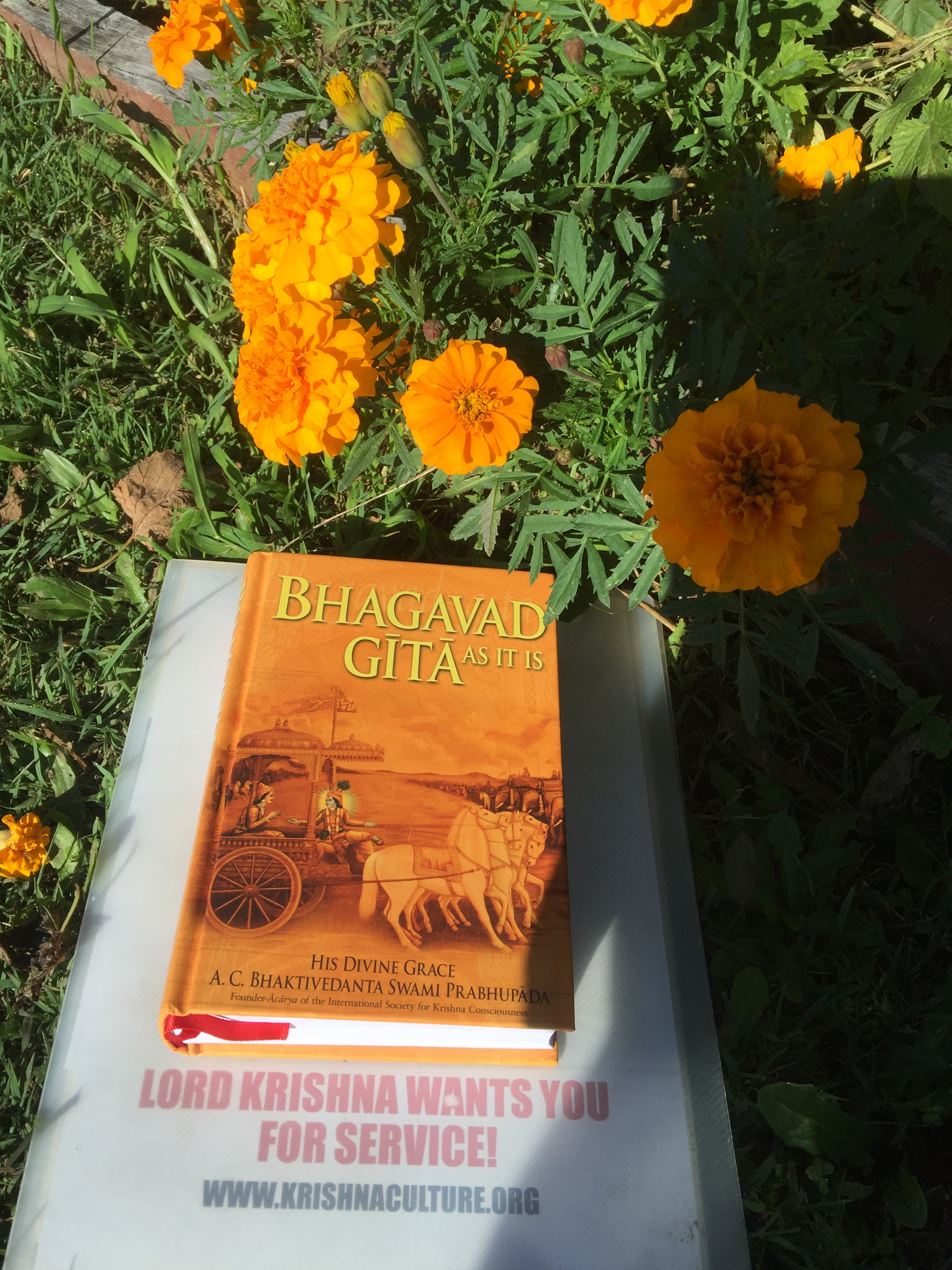
IMG_3641


Chapter 12 of Bhagavad-Gita As It Is is a short chapter. It has only 20 verses. It is along with chapter 15, the shortest chapter of the Bhagavad-gita. In total Bhagavad-gita comprises 700 verses, as if Sri Vyasadeva, the transcriber, liked round figures. We appreciate round figures too. It makes things easier. Chapter 18 is the longest chapter of the Bhagavad-Gita with 78 verses. It is seconded by chapter 2, with 72 verses, only 6 verses short of chapter 78.

Please find a Bhagavad Gita chapters breakdown. First number refers to chapter and the second number indicates number of verses found in the chapter:

.

1: 46 verses

2: 72 verses

3: 43

4: 42

5: 29

6: 47

7: 30

8: 28

9: 34

10: 42

11: 55

12: 20

13: 35

14: 27

15: 20

16: 24

17: 28

18: 78

A total of 700 verses!

Bhagavad Gita As It Is can be obtained for a small price from this very web site. Please go to tab “Bookstore” and order your copy today: https://krishnaculture.org/store/. It can be obtained from mobile Hare Krishna books distributors, from any Hare Krishna temple and restaurant or directly from our publishing house’s offices in Sydney, the Bhaktivedanta Book Trust http://www.bbt.org.au.

For the purpose of this article we shall concern ourselves with verses 13 to 20 of chapter 12 of Bhagavad- Gita As It Is by His Divine Grace A.C. Bhaktivedant Swami, the Founder-Acarya of the international Hare Krishna movement, started in New York city in the year 1965.

From verses 13-14, which are juxtaposed, to the end of the chapter 12, i.e. verse 20, Sri Krishna, the Supreme Personality of Godhead, described the requisites for someone who wants to be “very dear” to Him. This expression “very dear” is found verbatim in each and every verse. However in the last verse 12.20, the word “ativa” is used, which is translated as “very, very.” Here Sri Krishna even accentuates and increases the degree of dearness to Him by stating:

“Those who follow this imperishable path of devotional service and who completely engage themselves with faith, making Me the supreme goal, are very, very dear to Me.”

Yes indeed here is the formula to follow to become dear to Sri Krishna, just as there are formulas to follow for a successful business life. The devotees are in business for the pleasure of Krishna.

And who would not want to endear him or herself to the Supreme Personality of Godhead, Sri Krishna, literally the ultimate boss of everything and everyone! As the saying goes: “It is all about relationships.” And the most important relationship and the most congenial one of all is our relationship with the Supreme. This is exactly what is meant by the word “yoga” or the quality of our relationship with the Supreme. Now one may say: “Hang on a second: relationship with the Supreme? That’s really too far fetched! I live in the real world of everyday problems of life.” But everyday life is also a manifestation of the external energy of the Supreme. Why dissociate the two?

There are 29 indications of how one becomes dear to the Lord, as follows:

1) Who is not envious but is a kind friend to all living entities. This also means we cannot eat up our friends and brothers animals.

2) Who does not think himself a proprietor.

3) Who is free from false ego.

4) Who is equipoised in happiness and distress (repeated three times).

5) Who is tolerant.

6) Who is always satisfied.

7) Who is self controlled.

8) Who is engaged in devotional service with determination, his mind and intelligence fixed on Shri Krishna. (mentioned three times, including in whole verse 12.20)

9) He by whom no one is put into difficulty.

10) He who is not disturbed by anyone.

11) Who is equipoised in fear and anxiety.

12) Who is not dependent on the ordinary course of activities.

13) Who is pure.

14) Who is expert. He is always expert because he fully knows the essence of all activities of life and he is convinced of the authoritative scriptures.

15) Who is without cares. A devotee never takes the part of a particular party; therefore he is carefree.

16) Who is free from all pains. He is never pained, because he is free from all designations; he knows that his body is a designation, so if there are some bodily pains, he is free.

17) Who is not striving for some result.

Careful: this is a tricky expression. From the purport it is clear that it is meant that the pure devotee is not striving for some PERSONAL results. The devotee of the Lord is not a useless and aimless fellow because “he is not striving for some result”. Here are Srila Prabhupada words from the purport:” The pure devotee does not endeavor for anything which is against the principles of devotional service. For example, constructing a big building requires great energy, and a devotee does not take to such business if it does not benefit him by advancing his devotional service. He may construct a temple for the Lord, and for that he may take all kinds of anxiety, but he does not construct a big house for his personal relations.”

In the Srimad Bhagavatam 7.13.8, purport, Srila Prabhupada expresses it with even more clarity:

“Temples and monasteries should be constructed for the preaching of spiritual consciousness or Krishna consciousness, not to provide free hotels for persons who are useful for neither material nor spiritual purposes. Temples and monasteries should be strictly off limits to worthless clubs of crazy men. In the Krishna consciousness movement we welcome everyone who agrees at least to follow the movement’s regulative principles—no illicit sex, no intoxication, no meat-eating and no gambling. In the temples and monasteries, gatherings of unnecessary, rejected, lazy fellows should be strictly disallowed. The temples and monasteries should be used exclusively by devotees who are serious about spiritual advancement in Krishna consciousness.”

18) Who neither rejoices nor grieves.

19) Who neither laments nor desires.

20) Who renounces both auspicious and inauspicious things.

21) Who is equal to friends and ennemies.

22) Who is equipoised in honor and dishonor.

23) Who is equipoised in heat and cold.

24) Who is equipoised in fame and infamy.

25) Who is always free from contaminating association.

26) Who is always silent.

“He does not speak of anything but the topics about Krishna; therefore he is called silent. Silent does not mean that one should not speak; silent means that one should not speak nonsense. One should speak only of essentials, and the most essential speech for the devotee is to speak for the sake of the Supreme Lord.”

27) Who is satisfied with anything.

28) Who does not care for any residence.

29) Who is fixed in knowledge.

Posted in Uncategorized | Leave a comment

SRILA PRABHUPADA ON AIMLESS STUDY OF THE VEDAS OR IN A BROADER SENSE, ON AIMLESS CULTIVATION OF KNOWLEDGE.

The unhulled rice and the empty husks of rice look very much the same. One who knows how to get the grain out of the unhulled rice is wise, but one who beats on the empty husk, thinking to get some result, is simply wasting his labor uselessly. Similarly, if one studies the Vedas without finding the goal of the Vedas, Krishna, he simply wastes his valuable time. Letter to Dr. Staal, February 15, 1970

Posted in Uncategorized | Leave a comment

WEST BENGAL TOURISM OFFICE PRESENTS: ISKCON MAYAPUR, NADIA, WEST BENGAL, INDIA

Posted in Uncategorized | Leave a comment

US Congresswoman Tulsi Gabbard chants Hare Krishna in New York City.

Tulsi Gabbard, Member of the Hawaii House of Representatives (2002–2004), is U.S. Representative (2013–present) for Hawaii, 2nd congressional district, first Samoan American and first Hindu member of the United States Congress. She is a member of the Democratic Party.

The 2020 presidential campaign of Tulsi Gabbard, the U.S. Representative for Hawaii’s 2nd congressional district, began on January 11, 2019.


Posted in Uncategorized | Leave a comment

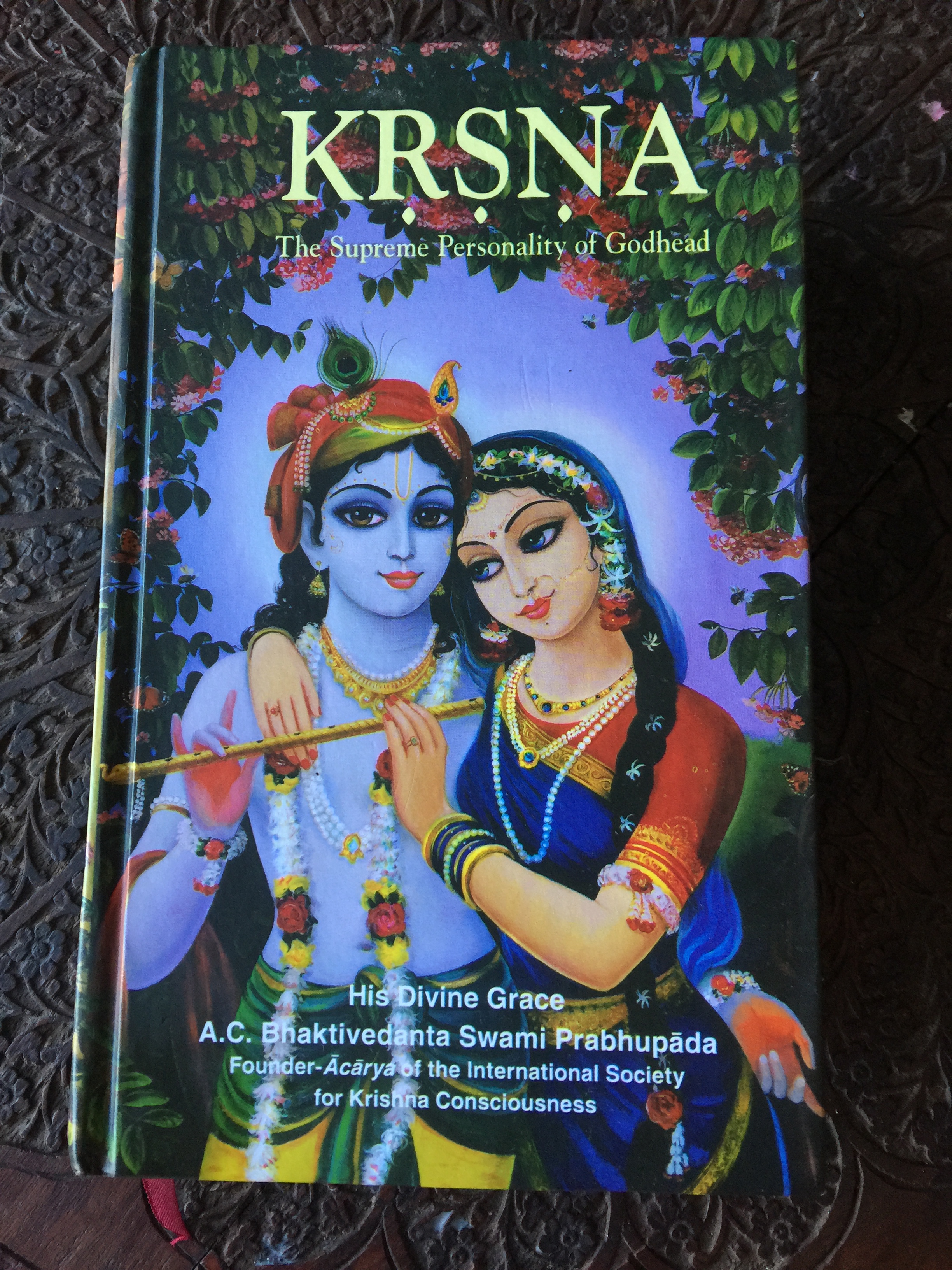
“Just as Krishna is the Supreme Personality of Godhead, Vaasudeva, Rukminii is the supreme goddess of fortune, Mahaa-Lakshmii.” Krishna Book, chapter 52.


“Just as Krishna is the Supreme Personality of Godhead, Vaasudeva, Rukminii is the supreme goddess of fortune, Mahaa-Lakshmii.” Krishna Book, chapter 52.

From this passage one may argue that “the Supreme Goddess of Fortune” be spelled with capital letters.

Why is it not spelled with capital letters?

Is it sexism again?

From this sentence  it is clear that there an equality of status and intimate relationship between the Supreme Personality of Godhead and the Supreme Goddess of Fortune. Therefore one may conclude that, if only by association, the nomenclature “the Supreme Goddess of Fortune” should be written with capital letters.

The Krishna Book text goes on:”According to the authority of the Caitanya-caritaamrta, the expansion of Krishna and that of Sriimatii Raadhaaraanii are simultaneous: Krishna expands Himself into various vishnu-tattva forms, and Sriimatii Raadhaaraanii expands Herself into various shakti-tattva forms, by Her internal potency, as multiforms of the goddess of fortune.”

We note that the personal pronoun “Herself” in reference to Sriimatii Raadhaaraanii is spelled with capital letter in this passage of Krishna Book.

So Sriimatii Raadhaaraanii is shakti-tattva and is consequently not equal to the Supreme Personality of Godhead Who is Vishnu-tattva. Shakti-tattva and Vishnu-tattva are two different categories of transcendental existence. But then again in Adi Lila 1.5 it is stated that “…Raadhaa and Krishna are one in Their identity…” Because of the parallel and the intimate association of shakti-tattva and Vishnu-tattva, it may be argued that the “Supreme Goddess of Fortune” and “Goddess of Fortune” in general be spelled with capital letters.

Such spelling will immediately remind us of the intimate relationship between the Supreme Personality of Godhead and the Supreme Goddess of Fortune and will prevent us from chasing  the association of the  Goddess of Fortune on her own, just as the shameless demon Ravana did.  There is a stern warning by Srila Prahupada, that if we don’t engage Laksmii in the service of Her Husband, the Personality of Godhead, Naaraayana, then Laksmii will ultimately kill us.

Prabhupaada: Provided you engage them for Krishna’s service. Otherwise the lakshmii will kill you. Just like Siitaas, Siitaa is Lakshmii. When Siiaa was taken by Raavana, the result was the whole family was killed because they did not use Siitaa for Raama’s service. [break] …householders can be engaged, not anyone else. 750701MW.Den

In 730726BG.Lon, Srila Prabhupada also says the following in this context:

“So they were actually aatataayinah. Because aatataayinah means one who comes to kidnap your wife, insults your wife, you should immediately kill him. Just like Lord Raamacandra. He was so pious king, but when it so happened that His wife, Siitaa, was insulted… Siitaa was taken away by Raavana. Lord Raamacandra could marry hundreds and thousands of Siitaas. He is the Supreme Personality of Godhead. He could create Siitaa, Raadhaaraanii , Lakshmii.
They are the pleasure potency of the Supreme Personality of Godhead. The Supreme Personality of Godhead cannot have a material wife or a material companion. Krishna’s Raadhaaraarii or Lord Raamacandra’s Siitaadevii, Naaraayana’s Lakshmiidevii, they are pleasure potency of the Supreme Personality of Godhead. Raadhaa krishna-pranaya-vikritir hlaadinii shaktir asmaat [Cc. Ädi 1.5]. Ählaadinii-shakti. Krishna, God, has got many potencies. One of the potencies is called aahlaadinii-shakti, pleasure potency. So Krishna’s consort, Lord Raamacandra’s consort, they are pleasure potency, exhibited.
So to show the example, Lord Rämacandra, because Siitaa was kidnapped, Siitaa was insulted, or Raamacandra was insulted, the retaliation was Lord Raamacandra killed not only Raavana but the whole dynasty, finished. Only for one woman. He could create so many. No. Because aatataayinah, aggressed over. Just to teach people that anyone, if he is aggressor, he must be killed. This is the position.”

In fact RESPECT and DISTANCE are required and therefore capital letters are required as in the “Goddess of Fortune”.  Thank you very much for reading me.

Posted in Uncategorized | Leave a comment

“You should all therefore preach with fearlessness and with utmost energy the message of Rupa and Raghunath under the guidance of the followers of Sree Rupa.” His Divine Grace Sri Srimad Bhaktisiddhanta Saraswati Goswami Maharaja, December 23rd 1936.


from BACK TO GODHEAD MAGAZINE 1944

 Edited and Founded Under Direct Order of His Divine Grace Sri Srimad Bhakti-Siddhanta Saraswati Goswami Prabhupada by Goswami Abhay Charan Bhaktivedanta.


His Divine Grace Sree Sreemad Bhakti Siddhanta Saraswati Goswami Maharaj the celebrated Acharya (Spiritual Head) of the Gaudiya Vaisnavas spoke the following few lines as His Message just a few days (23rd December, 1936) before His passing away from this mortal world.

“I have most probably given many people troubles in the mind. Some of them might have thought about me that I am their enemy because I was obliged to speak the plain truth for service and devotion towards the Absolute Godhead. I have given them all those troubles only for the reason that they may turn their face towards the Personality of Godhead without any desire for gain and with unalloyed devotion. I hope some day or other they may understand me rightly.”

“I advise all to preach the teachings of Rupa-Raghunath (disciples of Lord Chaitanya) with all energy and resources.

Our ultimate goal shall be to become the dust of the lotus feet of Sree Sree Rupa and Raghunath Goswamins. You should all work conjointly under the guidance of your spiritual master with a view to serve the Absolute Knowledge, the Personality of Godhead. You should live somehow or other without any quarrel in this mortal world only for the service of Godhead. Do not please give up the service of Godhead in spite of all dangers, all criticisms and all discomforts. Do not be disappointed for most people in the world do not serve the Personality of Godhead; do not give up your own service which is your everything and all, neither reject the process of chanting and hearing of the transcendental Holy Name of Godhead. You should always chant the transcendental Name of Godhead with patience and forbearance like a tree and humbleness like a straw.”

“We wish that this mass of our body of flesh and blood may be sacrificed at the altar of preaching the Samkirtan Movement (congregational chanting of the Holy Name of Godhead) propagated by Lord Chaitanya. We are not desirous of becoming a hero of work or a reformer of religion, but our reality may be identified with the dust of the Lotus Feet of Sree Rupa and Raghunath for that is our everything. The flow of the transcendental tide of the attraction of devotion will never be blocked, and you with your all energy shall devote yourself for fulfilling the desire of Sreela Bhakti Vinode Thakur. There are many amongst you who are well qualified and able workers. We have no other desire whatsoever.”

“There are certainly many difficulties while we are in this mortal world but it is not our business simply to be overwhelmed with those difficulties or to try to overcome them only. We must know even during the duration of our present life, as to what we shall gain after overcoming all those difficulties of life and what shall be the mode of our permanent existence. We must make an adjustment of all things that evoke our love and hatred and for those that we want and do not want. Attachment and detachment of this mortal world will engage us more and more as we become farther and farthest from the Lotus Feet of Sree Krishna.

When we are able to transcend the position of attachments and detachments of this mortal world and be attracted with the Holy Name of Godhead, it is then only we can understand the import of the transcendental service of Sree Krishna the Personality of Godhead. At the first instance the subject Krishna is startling and perplexing to us. Every one who is called by the name ‘man’ is more or less struggling knowingly or unknowingly to eliminate those invading elements what are baffling our conception of eternal need. It is our only duty to enter into the kingdom of eternal need.”

“We have no love or hatred for any one in this world. All arrangements made in this world are but temporary. There is, therefore, unavoidable necessity for that ultimate need for every one in this world. You should attain the transcendental loving service of the objective, being situated in concerted action for that one aim. Let there be a constant flow of the ideas and thoughts as conceived by Rupa Goswami and His followers. We shall not at any time show our slightest dejection for the seven tongued “Samkirtan” movement. If we have undaunted faith in it we shall then only achieve all perfections. You should all therefore preach with fearlessness and with utmost energy the message of Rupa and Raghunath under the guidance of the followers of Sree Rupa.”

(Translated from Bengali by His Divine Grace A.C. Bhaktivedanta Swami Prabhupada, Editor, Back to Godhead Magazine, Vol. 1. 1944)

[Please note: The articles in this series have been typed from copies of the original manuscripts which are sometimes unclear. As far as possible, every attempt has been made to reproduce them without change.]

Homepage

Posted in Uncategorized | Leave a comment