THE MAIN PROBLEM IN ISKCON IS THAT WE ARE DISRESPECTING SRILA PRABHUPADA, ITS FOUNDER-ACARYA ON A VERY LARGE, MASSIVE AND GRAND SCALE. THAT IS THE MAIN PROBLEM INDEED.

THE MAIN PROBLEM IN ISKCON IS THAT WE ARE DISRESPECTING SRILA PRABHUPADA, ITS FOUNDER-ACARYA ON A VERY LARGE, MASSIVE AND GRAND SCALE. THAT IS THE MAIN PROBLEM INDEED.

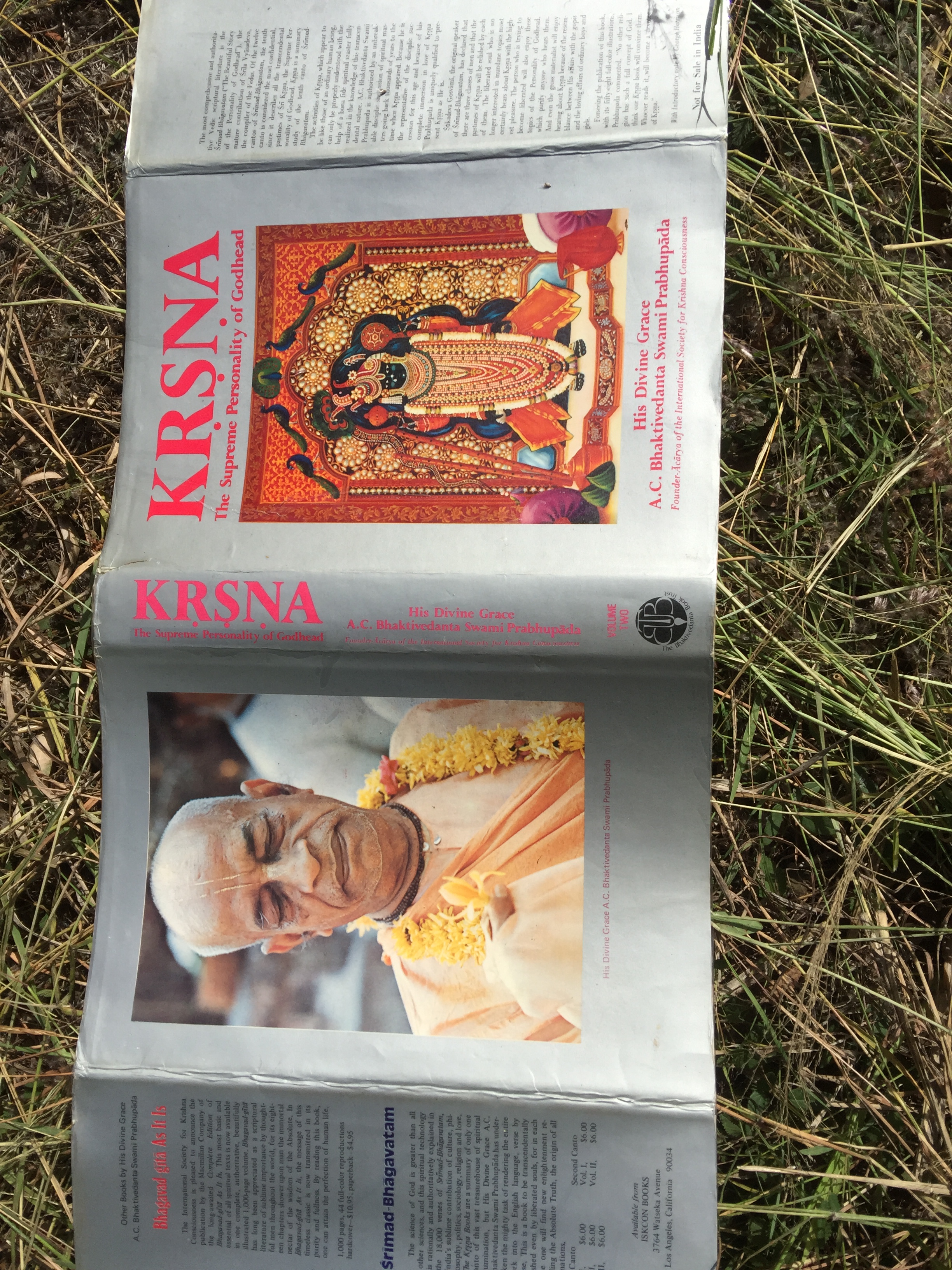
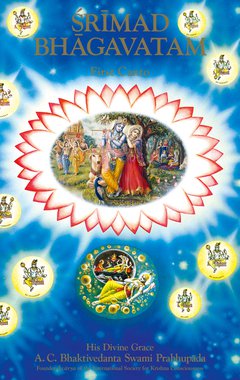
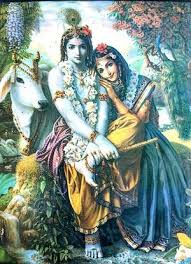
  1. THIS KRISHNA BOOK, FOR EXAMPLE, IS WONDERFULLY DESIGNED IN THAT THE FRONT COVER PAINTING IS JUST WONDERFULLY CRAFTED AND GIVES THE VIEWER AN IDEA OF THE INTIMATE LOVING RELATIONSHIP BETWEEN RADHA AND KRISHNA. HOWEVER THE BACK SIDE IS VERY DISRESPECTFUL TO SRILA PRABHUPADA IN THAT SRILA PRABHUPADA’S PICTURE IS TINY, WHEN IT SHOULD IN FACT SPREAD ON THE WHOLE BACK COVER, AS WAS THE CASE WITH THE EARLY BIG SIZE HARD BOUND KRISHNA BOOKS. (27 cm X 19 cm). The cows are bigger than Srila Prabhuapada. They may be Krishna’s cows, but Srila Prabhupada is Krishna’s sena-pati-bhakta.

IMG_3580

This is the cover of original h/b Krishna Book Vol II. If the Spiritual Master is to be given as much honor as the Supreme Lord, then this the correct presentation!

2)  HERE AT ISKCON BRISBANE, AFTER THE UNRESOLVED DISPUTES OF WHERE THE VYASASANA SHOULD BE SITUATED IN THE TEMPLE ROOM AND WHETHER OR NOT THERE SHOULD BE A FULL SET OF THE GLORIOUS CAITANYA CARITAMRTA IN THE TEMPLE ROOM OR NOT, WE HAVE YET ANOTHER TUSSLE IN PROGRESS IN THAT SRILA PRABUPADA IS OFTEN LEFT IN DARKNESS BECAUSE THERE IS NO PROPER AND INDEPENDENTLY CONTROLLED LIGHTING ON HIM SITTING ON THE VYASASANA. THIS HAS BEEN GOING ON FOR YEARS AND RECENTLY I HAVE STEPPED UP A CAMPAIGN  TO CORRECT THIS DEFECT. BUT UNFORTUNATELY THE MANAGEMENT IS VERY MUCH CALLOUS TO MY CALLS AND I HAD TO GIVE IT AN ULTIMATUM DEAD LINE.  THE DEAD LINE IS TODAY MAY 25TH 2019 AND IS NOW PASSED. IF ONE RECEIVES GOOD ADVICE AND DOES NOT FOLLOW FOR WHATEVER  REASON, THAT MEANS HE /SHE IS RASCAL, THAT MEANS HE / SHE IS FOOL AND RASCAL NUMBER ONE IN SRILA PRABHUPADA’S BOOKS. That mood of defiance against good advice is Maya. It is not Krishna!

Whoever one may be in the pecking order, one should have the good sense to accept good advice. When Sri Caitanya Mahaprabhu, the Supreme Personality of Godhead, in the garb of a Sannyasi left for South India, He accepted counsel from Sarva Bhauma Battacarya, the householder. Srila Prabhupada comments as follows:

“The word kariha asirvade means “continue to bestow your blessings upon Me.” Being a sannyasi, Caitanya Mahaprabhu was in the fourth order of life and was thus due all respect and adoration, whereas Sarvabhauma Bhattacarya, as a householder, was in the second order. A sannyasi is supposed to offer blessings to a grhastha, yet now, by His practical behavior, Sri Caitanya Mahaprabhu requested the blessings of a grhastha. This incident shows the special significance of Sri Caitanya Mahaprabhu’s preaching. He gave equal status to everyone, regardless of material considerations. His movement is thoroughly spiritual. Although apparently a grhastha (householder), Sarvabhauma Bhattacarya was unlike the so-called karmis interested in sense gratification. After being initiated by Sri Caitanya Mahaprabhu, the Bhattacarya was perfectly situated in the spiritual order; therefore it was quite possible for him to offer blessings even to a sannyasi. He was always engaged in the service of the Lord, even at home. In our disciplic line we have the example of a perfect householder paramahamsa — Srila Bhaktivinoda Thakura. In his book Saranagati, Bhaktivinoda Thakura states, ye-dina grhe, bhajana dekhi’, grhete goloka bhaya (Saranagati 31.6). Whenever a householder glorifies the Supreme Lord in his home, his activities are immediately transformed into the activities of Goloka Vrndavana, spiritual activities taking place in the Goloka Vrndavana planet of Krsna. Activities exhibited by Krsna Himself at Bhauma Vrndavana, the Vrndavana-dhama existing on this planet, are not different from His activities on the planet Goloka Vrndavana. This is proper realization of Vrndavana anywhere. In our Krsna consciousness movement we inaugurated the New Vrndavana activities, wherein devotees are always engaged in the transcendental loving service of the Lord, and this is not different from Goloka Vrndavana. The conclusion is that one who acts strictly in the line of Sri Caitanya Mahaprabhu is competent to offer blessings to sannyasis, even though he be a grhastha householder. Although he is in an exalted position, a sannyasi still must elevate himself to the transcendental platform by rendering service to the Lord. By His actual behavior, Caitanya Mahaprabhu begged the blessings of Sarvabhauma Bhattacarya. In this way He set the example of how one should expect blessings from a Vaisnava regardless of his social position. Madhya 7.70

STANZA 7 OF GURV-ASTAKA STATES:

” The Spiritual Master is to be honored as much as the Supreme Lord, because the Spiritual Master is the most confidential servitor of the Lord. This is acknowledged in all revealed scriptures and followed by all authorities. Therefore I offer my respectful obeisances unto the lotus feet of such a Spiritual Master, who is a bona fide representative of Sri Hari (Krishna).”

Therefore the lighting on Srila Prabhupada should be the same intensity and duration as the lighting shining on the Deities. To achieve this goal it also has to be independently operated.

One very nice thing about the ISKCON temple in Brisbane is that there is now a very nice parikrama path, perhaps one kilometre long or more. One can circumambulate Their Lordship Sri Gaura Nitai by turning right as one leaves the temple, then turning right again on the round about at 17 Mile Rocks road, then enter Rocks Riverside wonderful green park, through the first path on the right, which follows the bottom of the ridge where the temple is built. After passing under the remnants of the QCL conveyer belt, there is a steep path and stairs right up to the ridge and one joins again the south eastern corner of  the ISKCON land. Some of these steps are chiseled directly into the rocks, just like in India. One can see the marks of the chisel. This reminds one so much of India. If one has extra time one can walk in the park itself, which is also very attractive and full of greeneries, water ways and amusement for the kids and family. Additionally there is also a very large semi circular lawn, slightly inclined towards the river, which will just be perfect venue for holding a huge Krishna Sacred Sound Festival.

3) AND WHO THE HELL FOLLOWS SRILA PRABHUPADA ORDER TO HOLD THE MANGAL ARATIK FUNCTION EVERY DAY , 365 DAYS A YEAR, AT 04.30, WHERE EVER ONE MAY BE???

TO BE IN AN UPRIGHT POSITION AND WELL AWAKE BY 04.00 HOURS IS A FOUNDER-ACARYA’S ORDER AS BASIC AS TO CHANT  16 ROUNDS AND TO FOLLOW THE FOUR REGULATIVE PRINCIPLES. BUT AGAIN WHO THE HELL FOLLOWS ! OF COURSE, SOME DO FOLLOW VERY NICELY. WE THANK THEM VERY MUCH FOR THEIR DISCIPLINE AND ALL GLORIES TO THEM! BUT WHAT ABOUT THE OTHERS??? This particular measure is to help us overcome the all ubiquitous presence of the three modes of material nature. In the BGAII 2.45, Sri Krishna tells Arjuna: ” The Vedas mainly deal with the subject of the three modes of material nature. Rise above these modes, O Arjuna. Be transcendental to all of them. Be free from all dualities and from all anxieties for gain and safety, and be established in the self.”

I’d like to add BGAII 18.37: ” That which in the beginning may be just like poison but at the end is just like nectar and which awakens one to self-realization is said to be happiness in the mode of goodness.”

AND WHAT ABOUT THOSE WHO LIVE IN ISKCON ASHRAMS BUT NEVER EVER, EVER, EVER, EVER, EVER ATTEND FUNCTIONS IN THE TEMPLE ROOM. WHAT KIND OF BOORISHNESS, LOUTISHNESS AND CHURLISHNESS IS THAT? ISKCON BRISBANE DEFINITELY SUFFERS FROM THAT DISEASE AS WELL. It is also my understanding that Ashram residents MUST attend Mangal Aratik. When I was temple commander in Vrndavan under HG Akshoyananda Prabhu, he asked me to knock at every Ashram door to make sure residents would be ready, standing in front of Deities at 04.30 hours for the opening of the Mangal Aratik curtains.

Some residents really freaked out by this practice. But I was no to blame, as I merely performed my duty, under the order of the temple president of the time, HG Akshoyananda Prabhu, who, at this date, is fortunately still with us, as I found out recently, and hasn’t departed yet, as so many direct diksa disciples of Srila Prabhupada have.

AMONG THE TEN OFFENSES, OFFENSE NUMBER THREE READS:

TO DISOBEY THE ORDER OF THE SPIRITUAL MASTER OR IN OUR CASE THE ORDERS OF THE FOUNDER-ACARYA, HIS DIVINE GRACE A.C. BHAKTIVEDANTA SWAMI PRABHUPADA.

THAT MEANS ALSO WE DONT REALLY UNDERSTAND WHO SRILA PRABHUPADA IS. WE THINK HE IS AN ORDINARY INDIVIDUAL WITH AN EXAGGERATED SENSE OF HIS OWN PERSONALITY, WITH AN SWOLLEN SENSE OF HIS OWN EGO. BUT THIS IS VERY DANGEROUS MENTALITY. Shastra Srimad Bhagavatam 11.17.27 warns in this context:

The word kariha asirvade means “continue to bestow your blessings upon Me.” Being a sannyasi, Caitanya Mahaprabhu was in the fourth order of life and was thus due all respect and adoration, whereas Sarvabhauma Bhattacarya, as a householder, was in the second order. A sannyasi is supposed to offer blessings to a grhastha, yet now, by His practical behavior, Sri Caitanya Mahaprabhu requested the blessings of a grhastha. This incident shows the special significance of Sri Caitanya Mahaprabhu’s preaching. He gave equal status to everyone, regardless of material considerations. His movement is thoroughly spiritual. Although apparently a grhastha (householder), Sarvabhauma Bhattacarya was unlike the so-called karmis interested in sense gratification. After being initiated by Sri Caitanya Mahaprabhu, the Bhattacarya was perfectly situated in the spiritual order; therefore it was quite possible for him to offer blessings even to a sannyasi. He was always engaged in the service of the Lord, even at home. In our disciplic line we have the example of a perfect householder paramahamsa — Srila Bhaktivinoda Thakura. In his book Saranagati, Bhaktivinoda Thakura states, ye-dina grhe, bhajana dekhi’, grhete goloka bhaya (Saranagati 31.6). Whenever a householder glorifies the Supreme Lord in his home, his activities are immediately transformed into the activities of Goloka Vrndavana, spiritual activities taking place in the Goloka Vrndavana planet of Krsna. Activities exhibited by Krsna Himself at Bhauma Vrndavana, the Vrndavana-dhama existing on this planet, are not different from His activities on the planet Goloka Vrndavana. This is proper realization of Vrndavana anywhere. In our Krsna consciousness movement we inaugurated the New Vrndavana activities, wherein devotees are always engaged in the transcendental loving service of the Lord, and this is not different from Goloka Vrndavana. The conclusion is that one who acts strictly in the line of Sri Caitanya Mahaprabhu is competent to offer blessings to sannyasis, even though he be a grhastha householder. Although he is in an exalted position, a sannyasi still must elevate himself to the transcendental platform by rendering service to the Lord. By His actual behavior, Caitanya Mahaprabhu begged the blessings of Sarvabhauma Bhattacarya. In this way He set the example of how one should expect blessings from a Vaisnava regardless of his social position.
Madhya 7.70

>>> Ref. VedaBase => Madhya 7.70

acaryam mam vijaniyan
navamanyeta karhicit
na martya-buddhyasuyeta
sarva-deva-mayo guruh

WORD FOR WORD TRANSLATION

Word for word translation.acaryam — the spiritual master; mam — Myself; vijaniyat — one should know; na avamanyeta — one should never disrespect; karhicit — at any time; na — never; martya-buddhya — with the idea of his being an ordinary man; asuyeta — one should be envious; sarva-deva — of all demigods; mayah — representative; guruh — the spiritual master.

TRANSLATION

One should know the acarya as Myself and never disrespect him in any way. One should not envy him, thinking him an ordinary man, for he is the representative of all the demigods.

>>> Ref. VedaBase => SB 11.17.27

And as soon as Srila Prabhupada left the planet the ISKCON standards dropped significantly. The life members ship program, for example, was abandoned more or less. Just another burden Srila Prabhupada forced us to carry, right???

Yesterday 25 May 2019, at the Saturday Feast in Brisbane, one devotee told that his brother in law became a life members in New Dehli, India, about one year ago. Still he hasn’t received his Bhaktivedanta books. What kind of life member management is that???

One can abuse some people for all the time and all people for some time but it is impossible to abuse all people for all the time. Negative reaction will be there.

4) Another thing is that intra ISKCON communications are not up to scratch.

This indicates to me two things:

  1. A LACK OF COMPETENCE AND EVEN WORSE
  2. A LACK OF HONESTY!!!

As far as honesty is concerned, Srila Prabhupada makes the point that a brahmin is honest to the point of even endangering his own wholesomeness. “And Śrī Baladeva Vidyābhūṣaṇa has given about this ārjava, “simplicity,” he says that a brāhmaṇa even to a enemy will disclose all his secrets. Even to his enemy. Nobody discloses his secrets before an enemy, but a brāhmin, if he, even he finds out a enemy, he will disclose all the secrets. He has no secret. Brāhmin means open-minded, liberal. And the opposite word is kṛpaṇa, miser.” 721107SB.Vrn

Bhagavad-Gita As It Is 18.42 says additionally: “Peacefulness, self-control, austerity, purity, tolerance, honesty, knowledge, wisdom and religiousness—these are the natural qualities by which the braahmanas work.”

There is also a realm where lack of competence and dishonesty overlap.

5) Another intriguing change is as follows:

Since the departure of Srila Prabhupada it appears to me that the focus has changed from the spiritual to the mundane. Even if not spoken in plain language, it is however often implied that an advanced devotee must have the letters BA, MA or PhD after his name, otherwise he/she can absolutely not be advanced, whereas I am deeply satisfied to have the letters ACBSP after mine.

It should be noted that no mundane institution will ever deliver the letters ACBSP. In fact just “ACBSP” on its own  is so ultra precious because it is no longer available at all on the market. You may now ask  me: ” What market are you talking about?”  My reply will be: ” ACBSP   on its own, is not available any longer, on any market at all” “OUAOU”, will you say, “that facts makes it ultra dear, perhaps trillions and trillions of dollars.”   My reply will be: ” Yes, absolutely!” “But that’s highly unfair!” will the rightfully-transcendentally-intelligent-jealous shout out in desperate protest. My reply will be: ” Yes, absolutely!”  And to make it a fair level playing field, my suggestion will be to introduce the new system whereby we designate our relationships with our Divine Grace and Master, Om Visnupada Pramahamsa Astottara-sata Sri Srimad A.C. Bhaktivedanta Swami Prabhupada with the new system of designation as ACBSPgen1, ACBSPgen2, ACBSPgen3, ACBSPgen4. etc. etc. etc …..That will be the ACBSP dynasty. And that should appease the rightfully-transcendentally-intelligent-jealous. In fact that should appease everyone at all.

Now to get back to our actual subject matter. Yes, it appears to me that the focus has shifted in a spiritually unhealthy way from the spiritual to the mundane. In 750325CC.May, Srila Prabhupada defines advancement as follows: ” So study this Caitanya-caritāmṛta. Now we have got this English edition, very elaborately described, following the footsteps of our Guru Mahārāja, Bhaktisiddhānta Sarasvatī Ṭhākura Prabhupāda. So there is no such edition of Caitanya-caritāmṛta, very elaborately described.

But it can be understood by the advanced student. It can be… And so… Advanced, you can, anyone, you can become advanced. Advanced means at least one should understand that Kṛṣṇa is the Supreme Personality of Godhead. If you simply understand these two words, that Kṛṣṇa is the Supreme Personality of Godhead, then you are advanced.

It is not very difficult. Everything, all Vedic literature, they are meant for understanding Kṛṣṇa. Vedaiś ca sarvair aham eva vedyam [Bg. 15.15]. So if you simply understand… What is that understanding? That Kṛṣṇa is the Supreme Personality of Godhead. We have written in our Kṛṣṇa book, “Kṛṣṇa, the Supreme Personality of Godhead.” If you become convinced, then your study of Vedas—finished.”

So let us rightfully and conservatively adopt Srila Prabhupada’s own definition of advancement. A mundane learned fellow is not barred from advancement in Krishna Consciousness. Mental speculation can however be a hurdle for one’s advancement of Krishna Consciousness. Let me again quote Srila Prabhupada in BGAII 7.3, purport, to that effect:

“There are various grades of men, and out of many thousands, one may be sufficiently interested in transcendental realization to try to know what is the self, what is the body, and what is the Absolute Truth. Generally mankind is simply engaged in the animal propensities, namely eating, sleeping, defending and mating, and hardly anyone is interested in transcendental knowledge. The first six chapters of the Gita are meant for those who are interested in transcendental knowledge, in understanding the self, the Superself and the process of realization by jnana-yoga, dhyana-yoga and discrimination of the self from matter. However, Krsna can be known only by persons who are in Krsna consciousness. Other transcendentalists may achieve impersonal Brahman realization, for this is easier than understanding Krsna. Krsna is the Supreme Person, but at the same time He is beyond the knowledge of Brahman and Paramatma. The yogis and jnanis are confused in their attempts to understand Krsna. Although the greatest of the impersonalists, Sripada Sankaracarya, has admitted in his Gita commentary that Krsna is the Supreme Personality of Godhead, his followers do not accept Krsna as such, for it is very difficult to know Krsna, even though one has transcendental realization of impersonal Brahman.
Krsna is the Supreme Personality of Godhead, the cause of all causes, the primeval Lord Govinda. Isvarah paramah krsnah sac-cid-ananda-vigrahah / anadir adir govindah sarva-karana-karanam. It is very difficult for the nondevotees to know Him. Although nondevotees declare that the path of bhakti, or devotional service, is very easy, they cannot practice it. If the path of bhakti is so easy, as the nondevotee class of men proclaim, then why do they take up the difficult path? Actually the path of bhakti is not easy. The so-called path of bhakti practiced by unauthorized persons without knowledge of bhakti may be easy, but when it is practiced factually according to the rules and regulations, the speculative scholars and philosophers fall away from the path. Srila Rupa Gosvami writes in his Bhakti-rasamrta-sindhu (1.2.101):

sruti-smrti-puranadi-
pancaratra-vidhim vina
aikantiki harer bhaktir
utpatayaiva kalpate

“Devotional service of the Lord that ignores the authorized Vedic literatures like the Upanisads, Puranas and Narada Pancaratra is simply an unnecessary disturbance in society.”
It is not possible for the Brahman-realized impersonalist or the Paramatma-realized yogi to understand Krsna, the Supreme Personality of Godhead as the son of mother Yasoda or the charioteer of Arjuna. Even the great demigods are sometimes confused about Krsna (muhyanti yat surayah). Mam tu veda na kascana: “No one knows Me as I am,” the Lord says. And if one does know Him, then sa mahatma su-durlabhah. “Such a great soul is very rare.” Therefore unless one practices devotional service to the Lord, one cannot know Krsna as He is (tattvatah), even though one is a great scholar or philosopher. Only the pure devotees can know something of the inconceivable transcendental qualities in Krsna — His being the cause of all causes, His omnipotence and opulence, and His wealth, fame, strength, beauty, knowledge and renunciation — because Krsna is benevolently inclined to His devotees. He is the last word in Brahman realization, and the devotees alone can realize Him as He is. Therefore it is said:

atah sri-krsna-namadi
na bhaved grahyam indriyaih
sevonmukhe hi jihvadau
svayam eva sphuraty adah
[Cc. Madhya 17.136]

“No one can understand Krsna as He is by the blunt material senses. But He reveals Himself to the devotees, being pleased with them for their transcendental loving service unto Him.” (Bhakti-rasamrta-sindhu 1.2.234) [Surrender-Unto-Me] Bg 7.4, purport.

Srila Prabhupada clearly does not mention BA, MA or PhD in this definition of advancement. So there seem be here a major deviation here and a correction of trajectory is required indeed. This happens sometimes with the best of captain / pilots indeed. And in just a few measures, the boast /airplane will be on its right and correct course again.

6) There is also the question of use of capital letters throughout all books in all languages. As you can imagine and considering the number of books and translations, that’s quite extensive.

BBT editors unfailingly quote the following passage to justify their current use of capital letters:

No caps for Prabhupada pronouns or any of the acaryas. Prabhupada set the capitalization standard in a conversation with the BTG editors way back in 1969″

Satsvarupa: Prabhupada, in editing, there are two different policies about using capitals. One is to use as few capitals as possible or to use many capitals, in grammar capitalized, or to use few. So sometimes your Nectar of Devotion has got very few capitals. When Balarama is referred to as “he,” there is no capital. But the other policy is to always put… Krsna’s Hands, capital H, Krsna’s Feet, capital F, Krsna Who, capital W. Which is…
Prabhupada: No, no, no. Don’t follow that policy. That will not be very… Then…
Satsvarupa: The less capitals, the better?
Prabhupada: Yes. I think. What do you think?
Hayagriva: Well, I think, when referring to Krsna, we should always have a capital “H.”
Prabhupada: Especially. Yes. Especially for Krsna, you can.
Hayagriva: And if we want to, for Radha, capital “S.”
Prabhupada: But Balarama is not different from Krsna.
Satsvarupa: So He is capital “H.”
Hayagriva: So He is capital “H.” But then here we go. [laughter]
Prabhupada: No, no. You limit to these three. That will do.
Hayagriva: Limit to those three.
Prabhupada: Or Visnu. Yes. Visnu.
Hayagriva: What about avataras, in reference to Christ or Buddha?
Prabhupada: Buddha is capital use. Jesus Christ is capital used.
Satsvarupa: Yes. But he… Like “He.” He means Buddha, “Who.”
Hayagriva: No, “He.”
Prabhupada: No. That you can use…
Satsvarupa: Small.
Prabhupada: Yes.
Satsvarupa: Then words like Krsna’s “pastimes,” “entourage,” His “will.”
Prabhupada: No, small.
Satsvarupa: Small.
Prabhupada: Yes.
Hayagriva: The possessions of Krsna, small.
Prabhupada: Small.
Satsvarupa: His hands and feet, small.
Brahmananda: Lotus feet?
Prabhupada: Yes.
Satsvarupa: Lotus flower?
Prabhupada: Yes. All small. Simply name. Stick to name.
Hayagriva: The pronoun, Krsna, “who.” The pronoun “who,” that’s not…
Prabhupada: No, no. Use small.
Hayagriva: Okay. Thank you. There’s so many… That causes a headache for everyone.

>> Ref. VedaBase => Discussion with BTG Staff  —  December 24, 1969, Boston

But again Gurvastaka stanza 7 says:

“” The Spiritual Master is to be honored as much as the Supreme Lord, because the Spiritual Master is the most confidential servitor of the Lord. This is acknowledged in all revealed scriptures and followed by all authorities. Therefore I offer my respectful obeisances unto the lotus feet of such a Spiritual Master, who is a bona fide representative of Sri Hari (Krishna).”

On the basis of this authoritative statement of Shastra, we may say that “Spiritual Master” and possessives are to be written with capital letters. The pronoun “Who”, when relating to  the Supreme Personality of Godhead and the Spiritual Master should as well, from my humble point of French education view point, be written with capital letter. “Krishna, who” is simply not an option. Now for those who object that in the above passage Srila Prabhupada seems to ban “Krishna Who”, I shall simply reply that Srila Prabhupada is very kind in His dealings with His disciples and often simply satisfies their desires. All glories to Srila Prabhupada, the wisest, most learned and above all the most perfectly and completely Krishna conscious.!!! Let us follow Him only!

7)

And I find in ISKCON there is no dialogue.

There is only dictatorship of the controlling party (ies)

I don’t think this is what Srila Prabupada had in mind for His ISKCON. Again Srila Prabhupada is betrayed and disobeyed!!!

After all ISKCON is meant to be the house in which the WHOLE WORLD CAN FIND SHELTER.

Therefore there must be dialogue.

Here is a very nice Prabhupada letter passage on this point:

“I have seen the agenda of your president’s meeting. This is nice. One thing should be followed, however, as your countrymen are more or less independent spirited and lovers of democracy. So everything should be done very carefully so that their sentiments may not be hurt. According to Sanskrit moral principles, everything has to be acted, taking consideration of the place, audience and time. As far as possible the centers should act freely, but conjointly. They must look forward to the common development. That should be the principle. You are all intelligent boys, and you should be engaged in Krishna’s service. Then He will give you all intelligence. So in every action we should always pray to Krishna for His help so that we may act it nicely. Lord Krishna advised Arjuna yudhyasva mam anusmara [Bg. 8.7]. That should be our principle. We should use all our intellect as well as possible, and at the same time we should remember Krishna always.” 691013Let.TamalKrishna

For the post of temple president, Srila Prabhupada encouraged elections.

There is no doubt about it and here are 5 relevant passages all from Srila Prabhupada’s letters that election is the way to go for the post of temple president:

“Regarding the election of President, a president can only be changed by vote. If no vote was taken, then the president cannot be changed. Neither Hamsaduta can change the president whimsically or can anybody else change the president. According the “Direction of Management” the GBC cannot change the President but only by vote can it be done.” 74.9.29Let.Mukunda

“Regarding the intended election, I have no preference for anyone. Whomever gets the majority election, he has my vote.” 741016Let.londondevotees

“Regarding Sydney, that the President has left, if one does not follow the regulative principles, then he will leave. That is a fact. Has somebody else been elected?” 750804Let.Madhudvisa

“I congratulate you on your being elected as president of ISKCON San Francisco branch. Your election as president is a recognition by Krishna and therefore I have got full support for you. Mukunda and other members have rightly selected you as president. Your service attitude for Krishna and your sincere attempts at being advanced in Krishna Consciousness will work with you and make your life more and more glorious and a happy state. I’ve been very glad that you are appreciating by your self the effects of sincere Krishna Consciousness. I’ve nothing new to instruct you, the same old instruction namely constant chanting and attentively hearing the transcendental vibration Hare Krishna is the only process for self-realization in this age.” 670929Let.Jayananda

 “Jayananda is a very sincere and intelligent boy and I think his decision should be accepted as final in the matter. Not only in this case, but in every other complicated case. The elected authorities in the management of the temple should be the final authority in these matters. Otherwise, the society cannot be managed. Our main principle should be to advance the cause of K.C.”  680111Let.Gargamuni

But from my point of view, it would appear that the temple president of my home temple, ISKCON Brisbane, has self appointed himself and I am indeed happy to see evidence to the contrary. But until then I shall continue with my thesis. Such a foolish and infatuated act is worse that the worse dictatorship in the darkest places of the planet. Now Krishna has given him little reaction for this serious offense by letting him taste cancer.

Final Point.

BOOK DISTRIBUTION.

It is no secret that Srila Prabhupada could never be satisfied with the amount of BBT books distributed by His followers throughout the world. Last calendar year 2018, 9 425 998 pieces of literature were distributed throughout the world. To this date, June 2019, 550 million pieces of literature have been distributed since 1965 and we may be confident that Srila Prabhupada wishes us to double this figure ASAP.  It is a fact that book distribution generates more book distribution, as we can see that people are getting familiar with our BBT literature and are asking for more. Many of the people I meet know Bhagavad-gita As It Is and are asking for more titles, which are abundantly available such as Srimad Bhagavatam and Caitanya Caritamrta.

In letter dated January 16 1975 to Tripurari Prabhu, Srila Prabhupada issued a general request for everyone to contribute his / her bit to the book distribution effort. No one really is exempted from book distribution duties.

“My general request is that you all distribute as many books as possible and at the same time be very careful in dealings with others so that they may not become irritated with us. Your book sale statistics are astounding. I am so much pleased. Please continue distributing such nice quantities and try to enthuse others more and more. You are sincere, so Krishna will give you all intelligence, strength and everything else you may need to distribute millions and millions of books.” General Book Distribution Request. 750116let.Tripurari

and if we have to make a choice between temple worship and book distribution, the choice is crystal clear from the following passage of Srimad Bhagavatam 7.14.39, purport:

“….chanting of the Hare Krishna mantra is more powerful than Deity worship. Sri Caitanya Mahaaprabhu set a practical example in that He did not establish any temples or Deities, but He profusely introduced the sankirtana movement. Therefore Krishna consciousness preachers should give more stress to the sankirtana movement, especially by distributing transcendental literature more and more. This helps the sankirtana movement. Whenever there is a possibility to worship the Deity, we may establish many centers, but generally we should give more stress to the distribution of transcendental literature, for this will be more effective in converting people to Krishna consciousness.” SB 7.14.39, purport.

For those who want more convincing, I have published my Book Distribution Motivational Magazine (BDMM) available here. Please have a look.

Book Distribution Motivational Magazine, (BDMM).

Hare Krishna.

..

Posted in Uncategorized | Leave a comment

Through his expertise and conscientiousness HG Dravida Prabhu (ACBSP) of San Diego, USA, saves us again from tottering on the path of devotional service like partially blind people (andhah). LET US NOT BE TOTTERING FOOLS ON THE PATH OF DEVOTIONAL SERVICE, NO, NO, NO!!! Neither do we need a nanny GBC, or a nanny ISKCON administration. On the contrary let us be ourselves, each one of us, let us be very well conversant in Shastra, always alert and progressive on this “true path of eternal good fortune.” BGAII 6.47 P.

CC Adi 1.4 V1

May that Lord who is known as the son of Shriimatii Shaciidevii be transcendentally situated in the innermost chambers of your heart. Resplendent with the radiance of molten gold, He has appeared in the Age of Kali by His causeless mercy to bestow what no incarnation has ever offered before: the most sublime and radiant spiritual knowledge of the mellow taste of His service.

CC Adi 1.4 V2  improved by HG Dravida Prabhu.

May the Supreme Lord who is known as the son of Shriimatii Shacii-devii be transcendentally situated in the innermost chambers of your heart. Resplendent with the radiance of molten gold, He has appeared in the Age of Kali by His causeless mercy to bestow what no incarnation has ever offered before: the most sublime and radiant mellow of devotional service, the mellow of conjugal love.


COMMENTARY.

Chances are the first statement is not even true. Just see CC V1 claims to deal with the Absolute Truth but contains in fact false statements!!! What a paradoxal situation!!! Many incarnations have offered the taste of devotional service to the Supreme Personality of Godhead before the appearance of Lord Sri Caitanya Mahaprabhu. Sri Krishna, for example, has done so, when He almost orders us in BGAII 18.66: “Abandon all varieties of religion and just surrender unto Me. I shall deliver you from all sinful reactions. Do not fear.” This defects however are entirely the responsibility of the editors. They do not affect at all our perception and estimation of His Divine Grace A.C. Bhaktivedanta Swami Prabhupada, a spiritual genius and supremely towering figure in the landscape of service to Sri Krishna, the  Supreme Personality of Godhead.

In practical life we see that police persons, tree cutters, gutter and windows cleaners are all expert in their fields of activity, carry well honed equipment and risk serious injury or even death every day. The onus of perfection on those who claim to be servants of the Supreme Personality is even greater, because the task is much more important and the scope of activity is global. It is above all greater because their leader Sri Krishna, the Supreme Personality of Godhead IS THE GEATEST as He claims in BGAII 15.18, wherein He says: “Because I am transcendental, beyond both the fallible and the infallible, and because I am the greatest, I am celebrated both in the world and in the Vedas as that Supreme Person.”

We must also ensure that our training is always very rigorous according to the instructions of the Founder-Acarya of ISKCON: chanting minimum 16 rounds of Japa mala, following the four regulative principles very strictly and also raising from bed by four AM, at the latest and possibly attending Mangal Aratik at 04.30. This is a MUST for temple residents. Even Sri Krishna Himself set this example, as we learn from Krishna book, chapter 70, Lord Krishna’s Daily Activities; “Although Shriimatii Rukminiidevii, the first queen of Lord Krishna, knew that braahma-muhuurta is the most auspicious time in the entire day, she would feel disgusted at the appearance of braahma-muhuurta because she was not very happy to have Krishna leave her side in bed. Despite Shriimatii Rukminiidevii’s disgust, Lord Krishna would immediately get up from bed exactly on the appearance of braahma-muhuurta. An ideal householder should learn from the behavior of Lord Krishna how to rise early in the morning, however comfortably he may be lying in bed embraced by his wife.” This principle of early rising before 04.00 hours applies to all Ashrams indeed – sanyasi, vanaprastha householder and brahmacari and represents the spearhead for overcoming the influence of three modes of material nature. Because of the lure of sense gratification, it may be more difficult for the householder.

These elements will ensure success as the processus of Krsna consciousness itself is infallible.

All glories to Sri Krishna, the Supreme Personality of Godhead!!!

Sri Caitanya Mahaprabhu introduced indeed the mellow (to use Srila Prabhupada’s word) of conjugal love. And so did Srila Madhavendra Puri, the param Guru of Sri Caitanya Mahaprabhu, whose appearance day we celebrated just two days ago on Sunday May 19th 2019.

Here is Dravida Prabhu’s reasoning as to cause and effect for the improvement:

“The change in Adi 1.4 is pretty simple. We have Prabhupada’s synonyms at Adi 1.4: samarpayitum — to bestow; unnata — elevated; ujjvala-rasam — the conjugal mellow. In the translation this is rendered as “the most sublime and radiant spiritual knowledge of the mellow taste of His service.” But in Prabhupada’s translation of the same verse at Adi 3.4 this same phrase is rendered “the most elevated mellow of devotional service, the mellow of conjugal love.” The same translation appears at Antya 1.132. In consultation with my Sanskrit editor, and with the backing of 2 out of 3 of *Prabhupada’s own translations”, I made the change at Adi 1.4 so it would conform with the others.

Your servant,
Dravida dasa”

Dravida Prabhu (ACBSP) is such an important and essential link in the Sankirtan movement!!!

Without his most precious assistance, we would be tottering half blind (anda) along the path of devotional service, even though we have the most exalted and qualified leader in Srila Prabhupada. As Srila Prabhupada says, material nature and its workings will, over time, corrupt the most perfect creation.

And that’s where Dravida Prabhu (ACBSP) come in.

On so many occasions, he has now saved us from so many false paths and untruths.

All glories to his service!!!

And we thank him very much!!!

These things may seem simple to the expert like himself, totally immersed in the subject matter.

And he can also make them simple for us, by explaining so nicely, as he is doing.

These his explanations will also make things transparent, which is an essential quality in this age of distrust, paranoia and argumentation.

This particular change definitely feels great and welcome. But that is feeling.

“The inner most chambers of your heart” is such a grand expression!!!

Now he supplies reasoning as to cause and effect. That reasoning supersedes feeling as well as establishes the real and -why not- Absolute Truth. Yes there cannot be any reasonable objection to the change. Well done again Dravida Prabhu (ACBSP) and thank you very much!!!

Posted in Uncategorized | Leave a comment

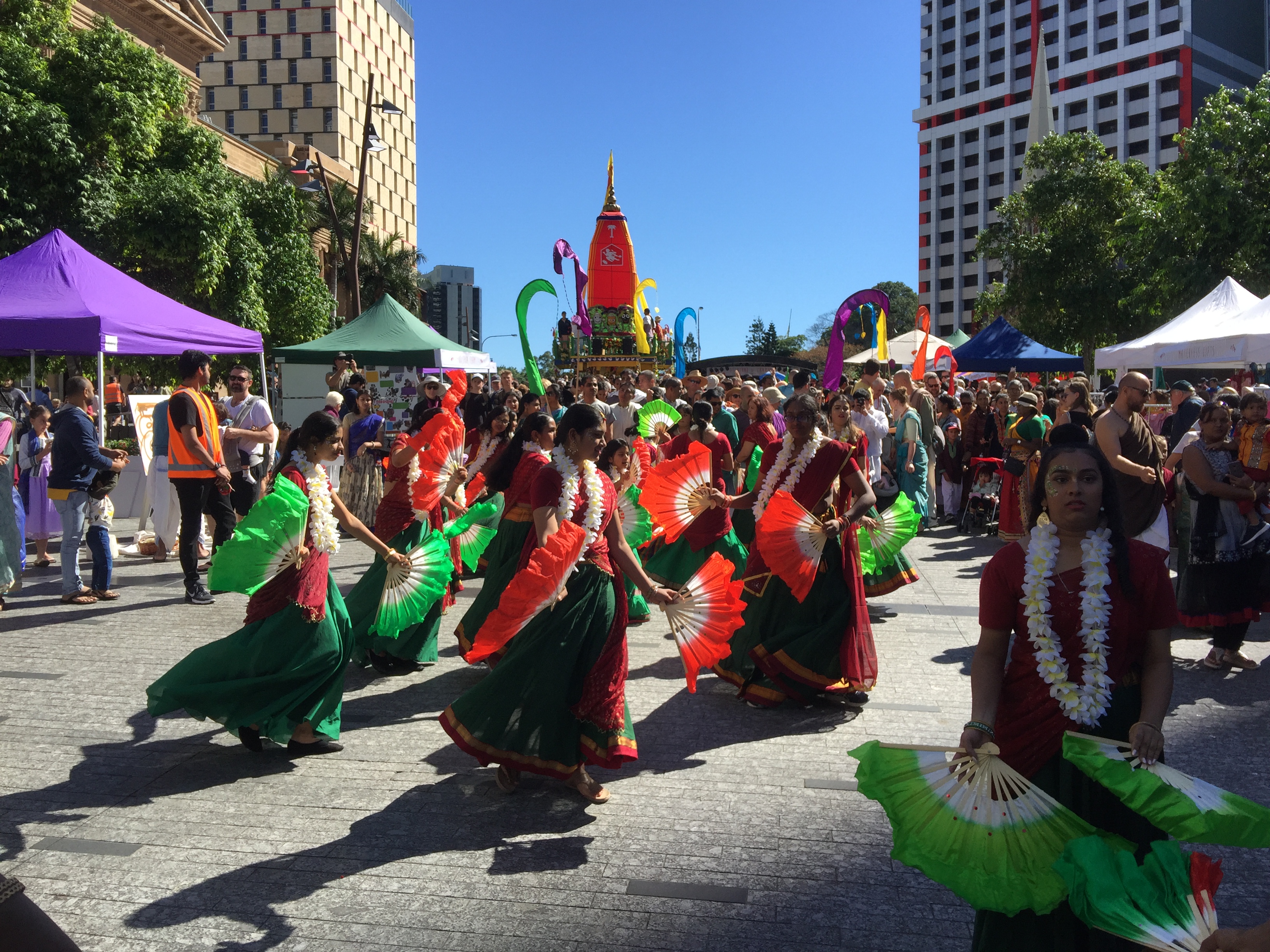
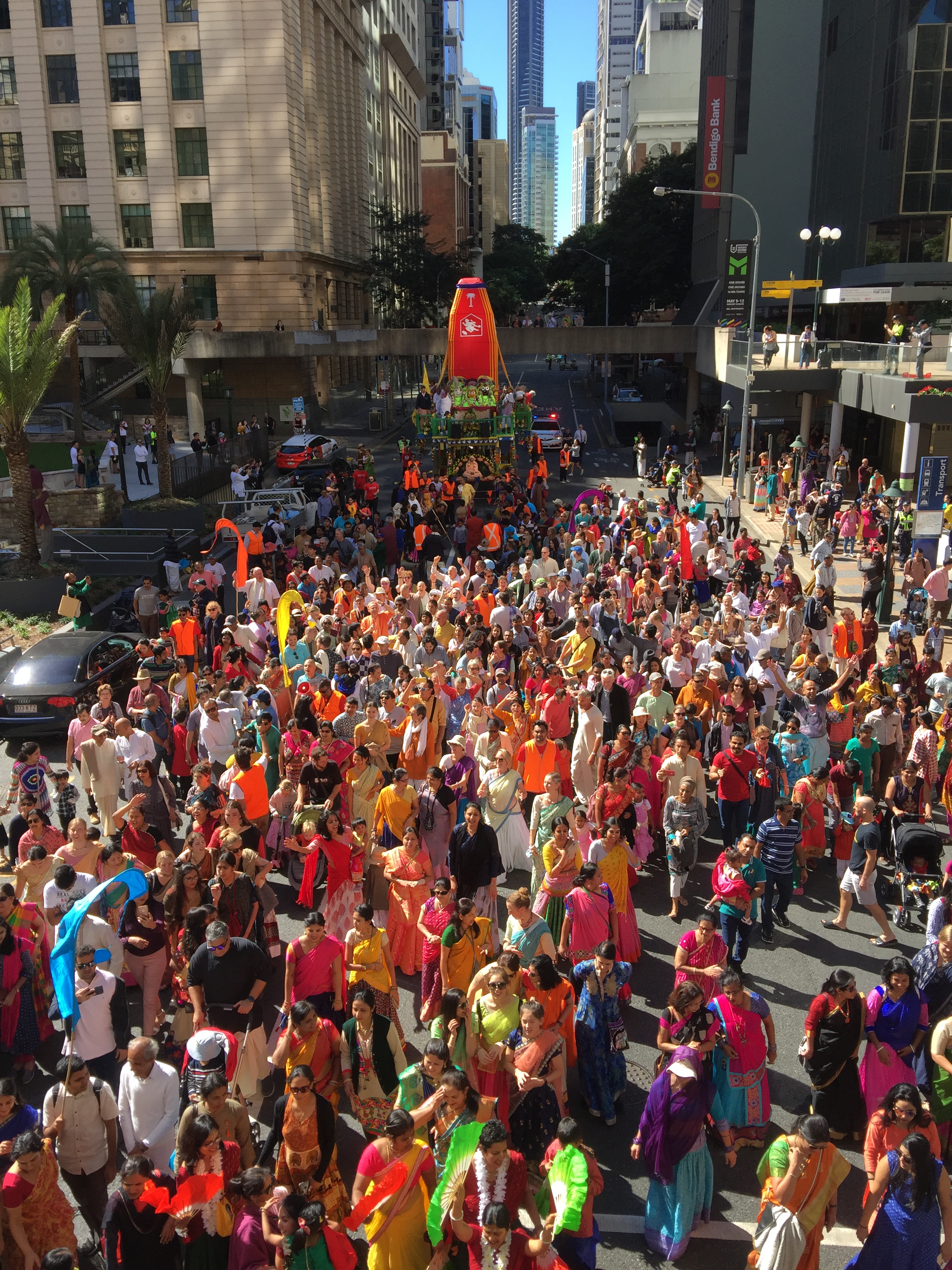
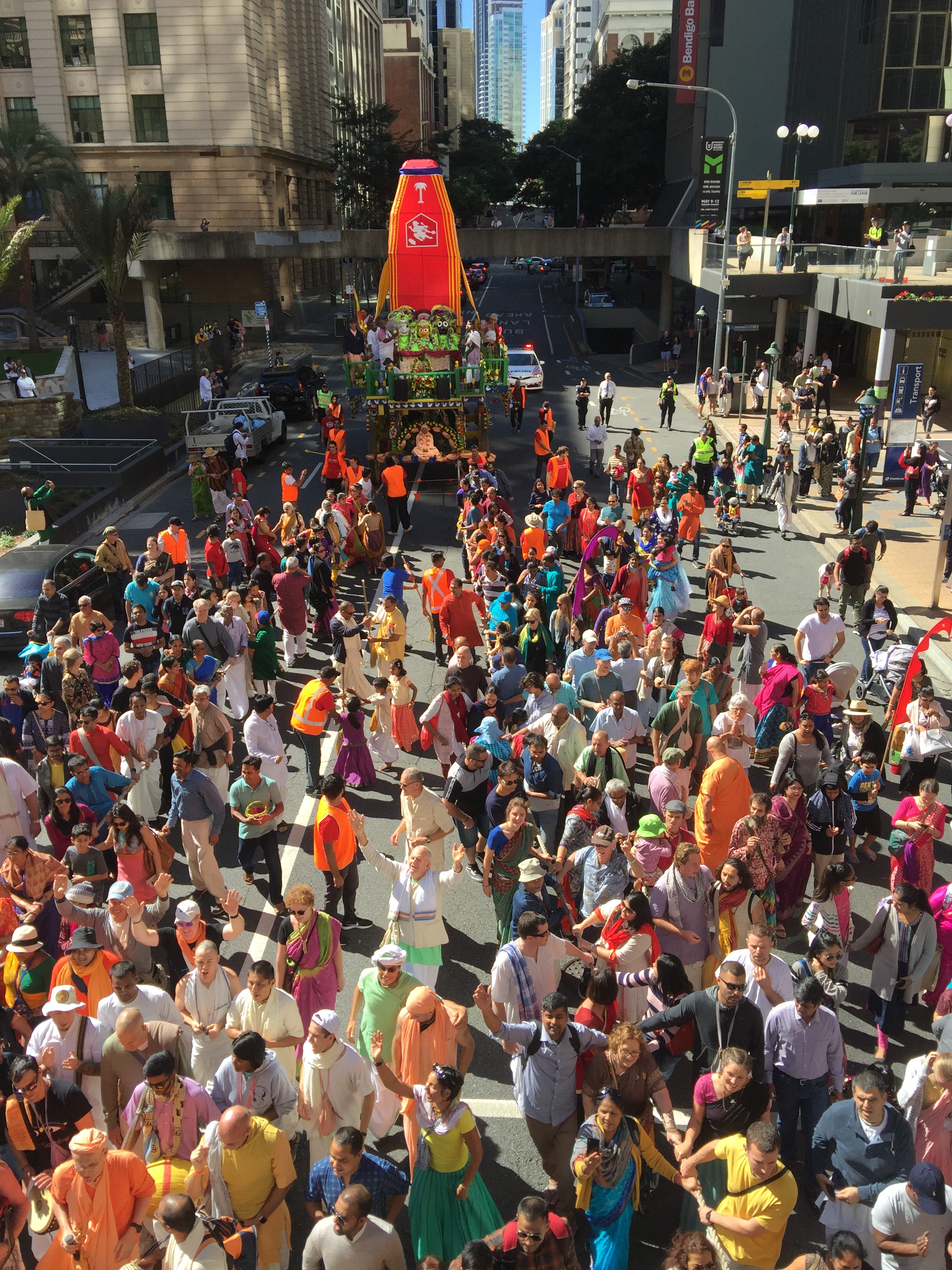
RATHAYATRA DAY. BRISBANE CBD, AUSTRALIA. 11 MAI 2019.

First thing in the morning, on RATHAYATRA day, during Mangal Aratik at 04.30 hours (and before indeed), Their Lordship Sri Sri Gaura Nitai displayed Their transcendental pastimes. They made the middle-row-of-temple-ceiling-lights-across flash constantly by divine intervention. There was no apparent reason for the flashing. They just flashed. Five bright lights flashed all together for quite some time. They had never flashed before in such a fashion. It looked very festival like!!! Thank you to and all glories to Their Lordships Shri Shri GAURA NITAI !!!

Then we went through the morning program and every one was very busy with their services to the Supreme Personality of Godhead. It was decided that His Holiness Kadamba Kanana Maharaja, who had just flown into town, would NOT give Srimad Bhagavatam class. Later he confirmed to me that it was the right decision, as this allowed him a small respite from his heavy international schedule.

The second consideration was that attendance to Srimad Bhagavatam class on RATHAYATRA DAY would decrease, as every one was busy with their respective services. I decided to give class anyway and attendance was about ten souls, which is good attendance, as per small temple standards. We should always remember that Srila Prabhupada advised us to never become discouraged and to give class to the bare walls, if we have to. Most importantly all programs as instituted by Srila Prabhupada Himself must go on simultaneously, without any interruption and in proper sequence, including the distribution of caranamrita after Deity greetings. This important function has recently been neglected and almost forgotten by ISKCON devotees in Brisbane. And that is why I mention it. Perhaps it is because they are too much eager to proceed with Guru Puja or worship of the Founder-Acarya of  The International Society for Krishna Consciousness, His Divine Grace A.C. Bhaktivedanta Swami Prabhupada, in which case they cannot be blamed. The distribution of the transcendental caranamrita nectar coming from the bathing of Their Lorsdship however, must go on as well and in proper sequence, as instituted by Srila Prabhupada Himself.

In His great wisdom, Srila Prabhupada instituted in ISKCON both pancaratriki viddhi (deity worship), as well as Bhagavat marg or anything to do with the books, shastra and the preaching effort outreach. Both must go on, just as a train needs two parallel rails to move forward. Every single temple program sequence in the ISKCON temples around the world is the same and Srila Prabhupada has instituted it with great thoughtfulness and specific purpose in mind. Our job is therefore super simple. We simply follow. This following definitely includes compulsory, daily attendance to Mangal Aratik for temple residents. We do not add anything. We do not subtract anything. And thus proceed straight on the path of an astounding success to come. Just watch.

Before RATHAYATRA procession, I tried to distribute Srimad Bhagavad-Gita As It Is to passers by and I found that people in their sheer vanity did not show much interest. The night before I had a very interesting experience, which strictly illustrates Srila Prabupada words to the effect that those who do not worship G – O – D, invariably develop a tendency to worship D – O – G and associated entities. There was a small group of people admiring two grey coloured and mid sized dogs on leash. Quite a boring matter really! I approached a lady and a gentleman and offered BGAII. The lady made immediately the following well assured and as if well informed statement: “ I dont believe in a God. There is no God!” Here we have this atheistic credo from the dog worshiping lady. Srila Prabhupada’s observations are always so very accurate! Srila Prabhupada is definitely the most scientific sankhya-yogi. He analysed the material nature with scientific rigor and gave His final verdict in His wonderfull books and classes. BGAII 5.5 “One who knows that the position reached by means of analytical study can also be attained by devotional service, and who therefore sees analytical study and devotional service to be on the same level, sees things as they are.” All glories to Srila Prabhupada, the Guru of the whole world!

Right from the beginning, the kirtan was exuberant. The devotees danced wildly at the rhythm of the mrdanga drums and cartal cymbals. It is a fact that if played well, the sound of the mrdunags is strong, compelling and sweet as confirmed in the Gaura-arati: “Shankha baaje ghantaa baaje baaje karataala madhura mridanga baaje parama rasaala” in English: ”Conchshells, bells, and karataalas resound, and the mridangas play very sweetly. This kiirtana music is supremely sweet and relishable to hear.”

It was as if a tsunami of joy and happiness inundated the mundane-noises-filled Central Business District of Brisbane. The high pitched voice of the lead singer, His Holiness Kadamba Kanana Maharaja could be heard all over. It was well amplified. His piercing voice surely pierced the three layers of the modes of material nature in the hearts of the conditioned souls. It surely also went all the way to Goloka Vrndavan to attract the attention of Srimati Radharani. To attract the attention of Srimatee Radharanai is a sure way to attract the attention of Sri Krishna, the Supreme Personality of Godhead. And if the Supreme Personality of Godhead smiles upon us, then not only is our life successful but the whole world becomes filled with joy and happiness as well. All glories to Sri Krishna, the protector of the cows and the brahmanas !!!

namo brahmanya-devaaya

go-braahmana-hitaaya ca

jagad-dhitaaya krishnaaya

govindaya namo namah

“My Lord, You are the well-wisher of the cows and the braahmanas, and You are the well-wisher of the entire human society and world.” (Vishnu Puraana 1.19.65) The purport is that special mention is given in that prayer for the protection of the cows and the braahmanas. Braahmanas are the symbol of spiritual education, and cows are the symbol of the most valuable food; these two living creatures, the braahmanas and the cows, must be given all protection—that is real advancement of civilization. In modern human society, spiritual knowledge is neglected, and cow killing is encouraged. It is to be understood, then, that human society is advancing in the wrong direction and is clearing the path to its own condemnation. A civilization which guides the citizens to become animals in their next lives is certainly not a human civilization. The present human civilization is, of course, grossly misled by the modes of passion and ignorance. It is a very dangerous age, and all nations should take care to provide the easiest process, Krishna consciousness, to save humanity from the greatest danger.” BGAII 14.16, purport.

We sung our hearts out:” Jai Jagannath, Jai Jagannath, Jai Baladeva, Jai Subhadra.” or in English “All glories to Lord Jagannatha, all glories to His brother Lord Baladeva, and all glories to Their beautiful sister Subhadra.” We also sang the refrain to the Jagannath Astaka, in the sweet melodies found in the movies “Nimai of Nadia” and “Nilacala Mahaprabhu”: “Jagannaathah Swaamii nayana-patha-gaami nayana patha gaami bhavatu me.” in English  language “May Lord Jagannaath be the object of my vision.” Certainly emotions were felt in relation to the Supreme Personality of Godhead, Sri Krishna. There was also a group of colourful, choreographed lady dancers in the front of the parade.

The weather was excellent. It was also a time to meet up with old friends of devotional service. Once back at St George’s Square in front of City Hall, immediately several lines formed for the famous and most popular free prasadam feature of Hare Krishna festivals. Prasadam means food that is first offered to the Lord in sacrifice by qualified brahmanas and excludes things such as meat, fish, eggs, onion and garlic, these items belonging to the modes of ignorance or tama guna.  The festival went on for a few more hours of transcendental entertainment.

One eager participant-spectator summed it all up in a few words. He said the HARE KRISHNA MAGIC IS HERE and he showed me in his bag an Indian kurta or shirt that he had just purchased. He was very proud to have the same shirt as the devotees. As Srila Prabhupada writes: “Imitation of a good thing, represents itself a good thing.”

Again for the second or third time members of the mormons church were also present. Hare Krishna and the mormons church seem to have a good relationship. I have heard that in Utah, USA, the mormons church made a financial contribution for the building of the Hare Krishna temple.

This yearly festival was organised by the Brisbane branch of The International Society for Krishna Consciouness founded in 1966 in New York, USA, by His Divine Grace A.C. Bhaktivedanta Swami Prabhupada, also Founder of the Bhaktivedanta Book Trust and the Back to Godhead magazine. It was edition number 6. His Grace Sriman Dvijavara Prabhu, disciple of His Holiness Indradyumna Maharaja, deserves special mention for leading a team of dedicated, expert and hard working volunteers to make this festival a resounding success.

Several city dignitaries accepted our invitation and sought the favor of Lord Jagannatha, the Lord of the Universe as follows by alphabetical order. We cordially thank them for their esteemed presence!

Mr. Umesh Chandra, CEO Chantex, Australian Citizen of the year 2019; Mrs and Mr Justin & Susan Handley, representing Bahai faith; Senior Sargent David Lucas, Cultural Engagement Unit, Queensland Police; Mr. Bart Mellish, member for Aspley; Dr Ram Mohan, President, Federation of Indian Communities Queensland; Ms. Margaret Naylon Executive Officer with The Council for Ecumenism; Ms. Gail Paratz, Interfaith Chair of Queensland; Mr. Palani O’Thevar, Social Worker, Secretary United Nations Association and finally Mrs. Archana Singh, Honorary Consul of India.

Posted in Uncategorized | Leave a comment

AUTHORISED, FULL FLUDGED AND BONA FIDE GURUS.

For those who are still in doubt as to the statuses of Srila Prabhupada bona fide and qualified Diksha disciples regarding Guruship, I may post the following letter which for the sincere and intelligent reader presents no alternative as to the conclusion to be reached on this matter: Srila Prabhupada bona fide and qualified disciples are full fledged and bona fide Gurus on their own right or have the option to take the position of full fledged and bona fide Gurus on their own right, remaining always under the knowledge and practice umbrella of our Founder-Acarya.

New Delhi
2 December, 1975
75-12-02

My Dear Tusta Krishna Swami,

Please accept my blessings. I beg to acknowledge receipt of your letter dated 21 November, 1975. Every student is expected to become Acarya. Acarya means one who knows the scriptural injunctions and follows them practically in life, and teaches them to his disciples. I have given you sannyasa with the great hope that in my absence you will preach the cult throughout the world and thus become recognized by Krishna as the most sincere servant of the Lord. So I’m very pleased that you have not deviated from the principles I have taught, and thus with power of attorney go on preaching Krishna consciousness, that will make me very happy as it is confirmed in the Guru vastakam yasya prasadat bhagavata prasadah just by satisfying your Spiritual Master who is accepted as the bona fide representative of the Lord you satisfy Krishna immediately without any doubt.

I am very glad to inform you that Sudama Vipra Maharaja is also now following my principles. So I am very very happy to receive all this news. Thank you very very much.

Keep trained up very rigidly and then you are bona fide Guru, and you can accept disciples on the same principle. But as a matter of etiquette it is the custom that during the lifetime of your Spiritual Master you bring the prospective disciples to him, and in his absence or disappearance you can accept disciples without any limitation. This is the law of disciplic succession. I want to see my disciples become bona fide Spiritual Master and spread Krishna consciousness very widely, that will make me and Krishna very happy.

I hope this letter finds you well,

Your ever well wisher,

A.C. Bhaktivedanta Swami
ACBS/hda


Moreover, in 750325CC.May, Srila Prabhupada gives yet another qualification of the Guru:

“So therefore guru is very important, because he has accepted Kṛṣṇa… Tattva-darśibhiḥ, he has seen the truth. So therefore guru is first offered. This is the test of guru. Guru does not become Kṛṣṇa Himself, but he canvasses door to door to induce that “You become devotee of Kṛṣṇa.” This is sign of guru. Vande gurūn īśa-bhaktān.

Posted in Uncategorized | Leave a comment

SRIMAD BHAGAVATAM. AMALA PURANAM. 7.13.34 “The behaviour of a perfect person.”

TEXT 34

shoka-moha-bhaya-krodha-
raaga-klaibya-shramaadayah
yan-muulaah syur nrinaam jahyaat
sprihaam praanaarthayor budhah

SYNONYMS
shoka—lamentation; moha—illusion; bhaya—fear; krodha—anger; raaga—attachment; klaibya—poverty; shrama—unnecessary labor; aadayah—and so on; yat-muulaah—the original cause of all these; syuh—become; nrinaam—of human beings; jahyaat—should give up; sprihaam—the desire; praana—for bodily strength or prestige; arthayoh—and accumulating money; budhah—an intelligent person.

TRANSLATION
Those in human society who are intelligent should give up the original cause of lamentation, illusion, fear, anger, attachment, poverty and unnecessary labor. The original cause of all of these is the desire for unnecessary prestige and money.

PURPORT
Here is the difference between Vedic civilization and the modern demoniac civilization. Vedic civilization concerned itself with how to achieve self-realization, and for this purpose one was recommended to have a small income to maintain body and soul together. The society was divided into braahmanas, kshatriyas, vaishyas and shuudras, and the members of this society would limit their endeavors to meeting their minimum demands. The braahmanas, in particular, would have no material desires. Because the kshatriyas had to rule the people, it was necessary for them to have money and prestige. But the vaishyas were satisfied with agricultural produce and milk from the cow, and if by chance there were excess, trade was allowed. The shuudras were also happy, for they would get food and shelter from the three higher classes. In the demoniac civilization of the present day, however, there is no question of braahmanas or kshatriyas; there are only so-called workers and a flourishing mercantile class who have no goal in life.
According to Vedic civilization, the ultimate perfection of life is to take sannyaasa, but at the present moment people do not know why sannyaasa is accepted. Because of misunderstanding, they think that one accepts sannyaasa to escape social responsibilities. But one does not accept sannyaasa to escape from responsibility to society. Generally one accepts sannyaasa at the fourth stage of spiritual life. One begins as a brahmacaarii then becomes a grihastha, a vaanaprastha and finally a sannyaasii to take advantage of the duration of one’s life by engaging oneself fully in self-realization. Sannyaasa does not mean begging from door to door to accumulate money for sense gratification. However, because in Kali-yuga people are more or less prone to sense gratification, immature sannyaasa is not recommended. Shriila Ruupa Gosvaamii writes in his Nectar of Instruction:
atyaahaarah prayaasash ca
prajalpo niyamaagrahah
jana-sangash ca laulyam ca
shadbhir bhaktir vinashyati
[Upadeshaamrita 2]
“One’s devotional service is spoiled when he becomes too entangled in the following six activities: (1) eating more than necessary or collecting more funds than required; (2) overendeavoring for mundane things that are very difficult to obtain; (3) talking unnecessarily about mundane subject matters; (4) practicing the scriptural rules and regulations only for the sake of following them and not for the sake of spiritual advancement, or rejecting the rules and regulations of the scriptures and working independently or whimsically; (5) associating with worldly-minded persons who are not interested in Krishna consciousness; and (6) being greedy for mundane achievements.” A sannyaasii should have an institution meant to preach Krishna consciousness; he need not accumulate money for himself. We recommend that as soon as money accumulates in our Krishna consciousness movement, fifty percent of it should be invested in printing books, and fifty per cent for expenditures, especially in establishing centers all over the world. The managers of the Krishna consciousness movement should be extremely cautious in regard to this point. Otherwise money will be the cause of lamentation, illusion, fear, anger, material attachment, material poverty, and unnecessary hard work. When I was alone in Vrindaavana, I never attempted to construct mathas or temples; rather, I was fully satisfied with the small amount of money I could gather by selling Back to Godhead, and thus I would provide for myself and also print the literature. When I went to foreign countries, I lived according to the same principle, but when Europeans and Americans began to give money profusely, I started temples and Deity worship. The same principle should still be followed. Whatever money is collected should be spent for Krishna, and not a farthing for sense gratification. This is the Bhaagavata principle.
Copyright BBT International.

Posted in Uncategorized | Leave a comment

Soweto, South Africa, Hare Krishna rap.

We have heard from authorities that there is a new Hare Krishna rap mantra in Soweto,  Johannesburg, South Africa. It goes like this:

Ain’t no party like a KRISHNA party, cause a KRISHNA party don’t stop hey!

Ain’t no party like a KRISHNA party, cause a KRISHNA party don’t stop hey!

Ain’t no party like a KRISHNA party, cause a KRISHNA party don’t stop hey!

Ain’t no party like a KRISHNA party, cause a KRISHNA party don’t stop hey!


My own additional refrain.

Yes, I have lost my heart in OUAGADOUGOU to Sri Sri Radha-Ouagadougouisvara hey!

Yes, I have lost my heart in OUAGADOUGOU to Sri Sri Radha-Ouagadougouisvara hey!

Yes, I have lost my heart in OUAGADOUGOU to Sri Sri Radha-Ouagadougouisvara hey!


Of course the absolute antecedent is:

krishna krishna krishna krishna krishna krishna krishna he
krishna krishna krishna krishna krishna krishna raksha maam
krishna krishna krishna krishna krishna krishna paahi maam
raama raaghava raama raaghava raama raaghava raksha maam
krishna keshava krishna keshava krishna keshava paahi maam

This song was sung by Lord Sri Caitanya Mahaprabhu Himself. Almost like a mad lion filled with ecstatic love of Godhead and performing Sankirtan, chanting Sri Krishna’s names as above, He, the Supreme Personality of Godhead Himself, disguised as a devotee (bhakta), went on His tour of South India. Caitanya Caritamrta Madhya 7. 95-96. This happened in the early sixteenths century, as we find on plate 3 of 18 volumes edition of Sri Caitanya Caritamrata, Madhya Vol 3. The plate reads as follows: “Mahaprabhu visited Mangalgiri in 1512 A.D. Chaitanya- Foot-prints installed by Paramhansa Bhakti Siddhanta Saraswati Goswami in 1930.”        All glories to Srila Prabhupada!!!


Posted in Uncategorized | Leave a comment

Here is Srila Prabhupada’s request and plan for Australia, the lucky Caitanya country.

Letter dated 31 December 1975 from Mumbai, India


My dear Madhudvisa Maharaja,

Please accept my blessings. Thank you for your nice invitation card. Thousands of Caitanya Mahaprabhu temples may be established all over Australia so that I may receive one invitation card at least every month. Physical health does not allow me to move very much, but my mind is absorbed in thinking of you with blessings of Krishna.

I hope this letter finds you well.

Your ever well-wisher

A.C. Bhaktivedanta Swami 

Posted in Uncategorized | Leave a comment

Please find two essential verses from Srimad Bhagavatam, amala Puranam. 1.2.9-10

SB. Text 1.2.9
All occupational engagements (dharma) are certainly meant for ultimate liberation. They should never be performed for material gain. Furthermore, according to sages, one who is engaged in the ultimate occupational service should never use material gain to cultivate sense gratification.
  SB Text 1.2.10
Life’s desires should never be aimed at gratifying the senses. One should desire only a healthy life, or self-preservation, since human life enables one to inquire into the subject matter of the Absolute Truth. This should be the goal of all one’s works.


The Sanskrit of verse SB 1.2.9 contains the word “apavargyasya” and in SB 7.13.25, chapter  13 being titled “The Behaviour of a Perfect Person”, and elsewhere, Srila Prabhupada gives a memorable explanation of the opposite term “pavarga”  as follows:

“….one may cultivate knowledge by which to become free from the evolutionary process and be reinstated in one’s original spiritual life.This is called apavarga, or liberation.

Material life is called pavarga because here we are subject to five different states of suffering, represented by the letters pa, pha, ba, bha and ma. Pa means parisrama, very hard labor. Pha means phena, or foam from the mouth. For example, sometimes we see a horse foaming at the mouth with heavy labor. Ba means byarthata, disappointment. In spite of so much hard labor, at the end we find disappointment. Bha means bhaya, or fear. In material life, one is always in the blazing fire of fear, since no one knows what will happen next. Finally ma means mrityu, or death. When one attempts to nullify these five different statuses of life–pa, pha, ba, bha and ma–one achieves apavarga, or liberation from the punishment of material existence.”


Posted in Uncategorized | Leave a comment

Proverbe du jour.

SRI SRI RADHA KRISHNA

The divine couple.


Tout vas se passer en temps utile. Ne t’ en fais pas. Vis dans le present car it est irremplacable. La somme d’un million d’ euro ne  saurait racheter le temps passe tandis que la récitation du Maha Mantra Hare Krishna le peut. Pour cette raison le Maha Mantra Hare Krishna a plus de valeur qu’ un million d’ euro, comme l’a demontre Sri Sanatan Goswami par son example pratique.


All things that are meant to happen will happen in due course. Do not worry. Live in the here and now for the present is irreplaceable. Not even one million dollars can buy back time. But the chanting of the Hare Krishna Maha Mantra can indeed. This chanting is therefore more valuable than one million dollars as Sri Sanatana Goswami has proven in practice.


HARE KRISHNA HARE KRISHNA

KRISHNA KRISHNA HARE HARE

HARE RAMA HARE RAMA

RAMA RAMA HARE HARE

Posted in Uncategorized | Leave a comment

Original Introduction to Bhagavad-Gita As It Is by none other than His Divine Grace Srila Prabhupada.

ORIGINAL.

INTRODUCTION TO GEETOPANISHAD

By

A. C. Bhaktivedanta Swami

All rights reserved BBT International

Faithfully and expertly digitized by HG Vrajananda Das


The Bhagavad-Gita is also known as Geetopanishad. It is the essence of Vedic knowledge and one of the most important Upanishads in Vedic literature.


There are many commentaries on the Bhagavad-Gita in English, and the necessity for another English edition should be explained on the following basis: an American lady asked me to recommend an English edition of the Bhagavad-Gita which she could read. I was unable to do so in good conscience. Of course, there are many English editions of the Bhagavad-Gita, but of those I have seen– not only in America, but also in India-none can be said to he authoritative, because in almost every one of them, the author has expressed his personal opinion through the commentaries without touching the spirit of Bhagavad-Gita as it is.

The spirit of Bhagavad-Gita is mentioned in the Bhagavad-Gita itself. It is like this: if we want to take a particular medicine, then we have to follow the directions written on the label of the bottle. We cannot take the medicine according to our own directions, or the directions of a friend not in knowledge of this medicine. We must follow the directions on the label or the directions of our physician. The Bhagavad-Gita also should be accepted as it is directed by the speaker Himself. The speaker is Lord Sri Krishna. He is mentioned on every page as the Supreme Personality of Godhead, or Bhagavan.

Bhagavan sometimes means any powerful person or demi-god, but here it means Krishna. This is confirmed by all the great acharyas, including Shankara and Sri Chaitanya Mahaprabhu.

In India there are many authorities on Vedic knowledge, and they have Virtually all accepted Sri Krishna as the-Supreme personality of Godhead. The Lord, Himself, also says in Bhagavad-Gita, that He is the Supreme Personality of Godhead.

We should therefore accept Bhagavad-Gita as it is directed by the Supreme Personality of Godhead, Himself.


Now, in the Fourth Chapter, the Lord tells Arjuna that this yoga system of the Bhagavad-Gita was first spoken to the Sun God.


“Imam vivasvate yogam proktavan aham avyam

Vivasvan manave praha manuriksakave vravit.

Evam parampara praptam imam rajassaya viduh

Sakalena mahata yoga nastah paramptapa.” (IV, I-2)

The Lord said, “My dear Arjuna, formerly I spoke this devotional service of Bhakti yoga to the Sun God. The Sun God told it to Manu and Manu told it to King Iksvaku. Thus all the saintly kings learnt this process of transcendental science of linking with the Supreme by such disciplic succession called Parampara, but at the present moment this chain of disciplic succession or teaching the science from authority to authority appears to be missing or lost.”


The clear direction is that the Bhagavad-Gita has to be understood through the chain of disciplic succession and not by personal interpretation as it has been in this modern age° Sri Krishna is here to re-establish this line of disciplic succession. Arjuna was chosen because, “You are my devotee and My friend; therefore, only you can understand.” Therefore the Bhagavad~Gita is especially meant for the devotee of the Lord.


“Sa eve ayam amya te adya yoga proktah purstanah

Bhaktahasi me sakha ca iti rahasyam hi etad uttamam.”

(BG IV 3)

“That oldest form of yoga system which was spoken to the Sun God some millions of years before is now Spoken to you again because you are My devotee and friend. Therefore you can understand the great mystery of this science of Bhakti yoga.”


Arjuna was neither a great scholar nor a Vedantist, but a great soldier. A soldier is not supposed to be scholarly, and yet Arjuna was selected to understand the Bhagavad-Gita because of one qualification only: he was a devotee of the Lord. This indicates that the Bhagavad-Gita is especially meant for the devotee of the Lord.


There are three kinds of transcendentalists: the yogi, the impersonalist, and the bhakta, or devotee. Krishna says to Arjuna, “I am making you the first man of the disciplic succession. The old succession is broken. I wish to re-establish the line of teaching which was passed down from the Sun God. So you become the authority of the Bhagavad-Gita” The Bhagavad-Gita is directed to the devotee of the Lord, who is directly in touch with the Lord as a friend. To learn the Bhagavad-Gita one should be like Arjuna: a devotee having a direct relationship with the Lord.


A devotee can be in relationship with the Lord in five different ways:


  1. He may have a passive relationship;


  1. He may have an active relationship;


  1. He may be in friendship;


  1. He may have the relationship of a parent;


  1. He may have the relationship of a conjugal lover of the Lord.


Arjuna was a devotee in relationship with the Lord as a friend. This friendship is different from friendship in the mundane world. This kind of friendship is transcendental. Everyone has some relationship with the Lord. Unfortunately in our present status, we have forgotten our eternal relationship with the Lord. Yet, each of the millions upon millions of living beings has a particular relationship with Him. By the process of service one can revive one‘s original relationship with the Lord.


Now, Arjuna was a devotee and he was in touch with the Supreme Lord in Friendship. “Thus, the Bhagavad-Gita was explained to him. How he accepted it should be noted. This is mentioned in the Tenth Chapter. After hearing the Bhagavad-Gita from the Lord, Arjuna accepted Krishna as the Supreme Brahman. Every living being is Brahman, but the Supreme Living Being is the Supreme Brahman. Arjuna accepted Krishna as pure– free from all material contamination; as the Supreme Enjoyer, as the foremost Person; the Supreme Personality of Godhead; never born; and greatest. How, one may say that, because Krishna and Arjuna were friends, Arjuna was only saying these things to his friend. Therefore, Arjuna mentions that Krishna is accepted as the Supreme Personality of Godhead, not only by himself, but by Narada, Vyasa, and numerous other great persons.


Therefore, Arjuna says, “Whatever You have spoken to me, I accept as perfect. Your personality is very difficult to understand. You cannot be known even by the demi-gods.” This means that even persons greater than human beings cannot know Krishna. How then, can a human being know Krishna, unless he is a devotee?


In studying Bhagavad-Gita, one should not think that he is the equal of Krishna. Krishna is the Supreme Personality of Godhead. One who wants to understand Bhagavad-Gita should accept Krishna as the Supreme Personality of Godhead. Otherwise it is very hard to understand, and it becomes a great mystery.


This Bhagavad-Gita is meant for delivering persons from the nescience of this material entanglement. Everyone is in difficulty, just as Arjuna was on the battlefield of Kurukshetra. Not only Arjuna, but each of us is full of anxieties because of this material entanglement. Our existence is eternal, but somehow we are put into this position which is asat. Asat means unreal.


Unless one is inquiring as to why he is suffering, he is not a perfect human being. Humanity begins when this inquiry is awakened in the mind. Every activity of the human being is said to be a failure unless this inquiry is present in the mind. One should ask, “Where am I from? Where am I going? Why am I here?” When these inquiries are awakened in the mind of a sane human being, then he can understand Bhagavad-Gita. He must also have respect for the Supreme Personality of Godhead. Krishna comes here just to establish the real work of life, which man forgets. Out of many, many human beings who awaken, the Bhagavad-Gita is directed to the one who seeks to understand his position. The Lord has great mercy for human beings. Therefore, He spoke the Bhagavad-Gita to Arjuna to enlighten him. Arjuna was actually above all such ignorance, but he was put into ignorance on the battlefield of Kurukshetra just to ask what life was all about, so that our mission of human life can be perfected.


It is the preliminary study of the Science of God which is explained here. The first question is; What is the cause? Next what is the constitutional position of the living entities, or Jiva, in respect to the controller, or Iswara.Living entities are not Iswara.If I say, “I am not controlled, I am free,” I do not speak well for my sanity. In this conditioned state of life, at any rate, we are all controlled. Next we may consider prakriti, or nature. Then time– the duration of the existence or manifestation of this created universe. Then karma, or activity. The living beings are all engaged in different activities. All cosmic manifestation is engaged in activity. So, we have to learn from Bhagavad-Gita what God is. What is the nature of Jiva, living entities? Their relationship with Iswara, the Supreme Controller? What is prakriti, the cosmic manifestation? What is the control of Time, and what are the activities of the living entities?


In the Bhagavad-Gita it is established that the Supreme Godhead, or Krishna, or Brahman or whatever you like– the Supreme Controller– is greatest of all. The living beings are controlled. The Lord has control over universal affairs — the material nature. Material nature is not independent. It is working under the direction of the Supreme Lord. When we see wonderful things happening, we should know that behind these manifestations, there is a Controller. Matter belongs to the inferior prakriti; and the living entities are explained as superior prakriti. Prakriti means “who is controlled.”Prakriti is female. Like a husband controls the activities of his wife, prakriti is also subordinate, predominated. The Lord– the Supreme Personality of Godhead-is the predominator, and prakriti– the living entities and material nature-— is predominated. So, according to the Bhagavad-Gita the living entities, although they are part and parcel of the Supreme, are taken as prakriti. It is clearly mentioned in the Seventh Chapter of Bhagavad-Gita that this material nature is prakriti and that the living entities are also prakriti. The constitution of the material, or inferior prakriti, is divided into three modes: the mode of goodness, the mode of passion, and the mode of ignorance. Above these modes is eternal Time. By the combinations of these modes and the control of eternal Time, the activities, called karma, come into being. These activities have been going on from time immemorial, and we are suffering from, or enjoying the fruits of these activities, just as in the present life we enjoy the fruits of our activities. It is as though I am a business man who has worked very hard and intelligently and have amassed a large bank balance. I am the enjoyer of the fruits of my activities. Again, if I open a business with a large amount of money and lose it all, I am the sufferer. Similarly, in the field of life, we enjoy the different fruits of our work, Now, these things– Iswara, the Supreme Lord, jiva the living entities, prakriti or nature, Time, and karma are explained in the Bhagavad-Gita .


Of these five, the Lord, Time, and the living entity are permanent and eternal. The manifestations of Prakriti are temporary, but not false, as some philosophers say. According to the philosophy of the Vaishnavas, the manifestations are quite real, but temporary. They are like the clouds which appear during the rainy season, but disappear during the dry season. These manifestations occur at certain intervals and then they disappear and the vegetation dries up. Nevertheless, this process of Nature is working eternally.


Material nature is separated energy of the Supreme Lord. The living entities are also the energy of the Lord, but they are not separated. They are eternally related with the Lord. So, the Lord, Nature, the entity and Time are all eternal. Karma is not eternal. The effects of karma may be old, and we may be suffering from the results of activity performed from time immemorial, but we are able to change our activities. We simply do not know which activities will give us release from these material entanglements, but this is explained in the Bhagavad-Gita.


The position of Iswara is that of Supreme Consciousness. The entities, being part and parcels, are also consciousness. The entity is explained as prakriti, or Nature, and so also is material energy. But the living entities are conscious, and matter is not. Therefore, the jiva is called the higher energy. But the jiva is never supremely conscious at any stage. The Supreme Consciousness, explained in the Bhagavad-Gita as the Lord, is conscious, and the living beings are conscious. The jiva is conscious of his limited body, but the Lord is infinitely conscious. The Lord lives in the heart of every being. Therefore, he has the consciousness of all living entities.


The paramatma is living in each heart as the controller. He is giving directions to act as He desires. The living entity, however, forgets what to do. He determines to act in one way, then becomes entangled in his own actions and reactions and achieves only frustration. When he gives up one body for another, as one changes a dress, the reactions of his past activities remain with him, determining his next birth. Actions can be changed when a living being is in goodness, and, in that state of sanity, he chooses to end his entanglement.


So, of the five items, all are eternal, except karma. Now, the entity’s consciousness and the Lord’s consciousness are both transcendental. They are not generated by association with matter. The theory that some material combination can generate consciousness is  reflected in Bhagavad-Gita. Just as a light may be reflected according to the colour of the glass, consciousness is reflected in the material world. But it does not depend upon matter for its existence.


The Supreme Consciousness, Iswara, is different from consciousness of the living entity in this way:the. Supreme Lord says that when He descends into the material world, His consciousness is not materially affected. If He had been contaminated by contact with matter, He could not have spoken Bhagavad-Gita. However, we living entities are contaminated by the material world. The Bhagavad—Gita teaches that we must purify our activities in order to draw our consciousness back from material entanglement. This purification of activity is called bhakti. Bhakti means that, although one’s activities appear to be ordinary, they are actually purified. One may appear to work like an ordinary man, but the activities of a devotee of the Lord are not contaminated by the three gunas, or modes.


When our consciousness is contaminated by matter, this is called our conditioned state. The false ego is the belief that one is the product of this matter. One who is absorbed in this bodily conception, as Arjuna was, must get free from it. This is a preliminary for one who wants liberation. Freedom from this material consciousness is called mukti. In Srimad Bhagavatam,also, mukti is used to mean liberation from this material concept and to return to pure consciousness. The whole aim of Bhagavad-Gita is to teach us to reach this state of pure consciousness. On the last page of Bhagavad-Gita, Krishna asks Arjuna if he is now in purified consciousness.

This implies action in accordance with the directions of the Lord.


So, consciousness is there, but because we are only parts, I we tend to be affected by the modes of Nature. That is the difference between the individual living entities and the Supreme Lord. In contamination, consciousness says, “I am the Lord. I am the enjoyer.” Every material being thinks this. Consciousness has two psychic divisions. One says, “I am the Creator,” and the other says, “I am the Enjoyer.” Actually, the Lord is the Creator and the Enjoyer. The entity co-operates like a part in a machine. In the body, for example, there are hands, legs, eyes, etc. . But these parts are not the enjoyers. The stomach is the enjoyer. All the parts of the body are engaged in satisfying the stomach. Everything should be given to the stomach. You can become healthy throughout your entire body when the parts of the body co-operate with the stomach. Similarly, the Lord is the enjoyer and we living beings have only to co-operate with Him. If the fingers try to enjoy the food, they are unable. They must give the food to the stomach in order to receive the benefit of it.


The central figure in existence is the Supreme Lord. The entities, by cooperation, can enjoy. If a master is satisfied, his servants are also satisfied, of course. The entities have this tendency to create and enjoy because the Lord has it, and the entities are His parts and parcels.


We find, in Bhagavad-Gita, that the Lord, the entities, manifestation, Time and action are completely explained. Taken together, this complete whole is called the Absolute Truth, Sri Krishna. The Impersonal Brahman is also subordinate to the Complete Person. It is explicitly explained in the Brahma Sutra as being like the rays of the sun emanating from the sun disc. Brahman realization of the Absolute Truth is therefore incomplete. The Supreme Personality is above Brahman. The Supreme Personality of Godhead is called Sat-Chit-Ananda.


Brahman realization is realization of His Sat, or eternity feature. Paramatman realization is realization of His Sat-Chit aspect– eternity and knowledge. But, realization of the Personality of Godhead, Sri Krishna, is realization of all feature — Sat-Chit-Ananda– in full vigraha, or form. The Lord has Form. He is a transcendental person. This is confirmed in all Vedic literature. Just as we are persons,  so is the Ultimate Truth. Realization of the Supreme Personality of Godhead is realization of all the features of the Absolute Truth. The complete whole Personality must have all that we see and all that we do not see.


This phenomenal world is also complete by itself. The twenty-four elements of which this manifestation is comprised are complete in this universe. No further outside energy is needed. When the time is complete, the universe will be annihilated by the complete arrangement of the Complete. Small completes exist in the whole Complete. Incomplete knowledge results from misunderstanding of the complete Absolute Truth.


Bhagavad-Gita is complete. The Vedic knowledge is infallible. Here is an example of how the Hindus accept Vedic knowledge as complete. Cow dung is sacred according to Vedic scripture. If one touches the dung of an animal, he must bathe his whole body, and yet cow dung can purify an impure place or person, according to Vedic scripture. This seems contradictory, but because it is a Vedic injunction, we accept it, and, by that acceptance, we make no mistake. It has been found by modern chemists that cow dung is a composition of all antiseptic properties.


Vedic knowledge is complete, as it is above all doubts or errors. And Bhagavad-Gita is the essence of all Vedic knowledge. Vedic knowledge comes down from higher sources. It is not like our material research work, which is imperfect. We must receive this knowledge from the spiritual master, through the disciplic succession, which began with the Lord Himself.


Just as Arjuna accepted Bhagavad-Gita without any alteration, so we too must accept Bhagavad-Gita without aux/cutting, interpretation, or whimsy. “6 should accept it as perfect knowledge, spoken by the Lord Himself. Only the Lord could have given this infallible knowledge. A living entity would not be able to.


A living being in the mundane world has four defects:


  1. He is sure to commit mistakes.


  1. He is sure to be illusioned.


  1. He has a tendency to cheat.


  1. His senses are imperfect.


With these four defects, one cannot offer perfect information. Vedic knowledge was imparted by God in the heart of Brahma, the first living being in our universe, who passed it down through his sons.


Except for the Lord, no one is the proprietor of anything. The Lord is the original Creator. He is the creator of Brahma, the original being in our universe. Therefore, we should accept things given to us by the Lord as our allotment. Arjuna had decided not to fight. He told the Lord that he could not enjoy the kingdom if he killed his relatives to obtain it. This was due to his bodily concept of himself, and thus his relationship with uncles, brothers, nephews, and so forth, all these relationships pertain to the body. But finally, Arjuna agreed to work for the Lord’s enjoyment. He should not act like ordinary animals. Human life is meant for something else. Vedic literature is meant for human beings, not for animals. An animal can kill without sin because he is bound by the modes of his nature. But, if a man kills, he is responsible. He has a choice in his actions.


In Bhagavad-Gita, activities are explained as determined by the three modes of nature. Thus, there are actions performed in ignorance, in passion, and in goodness. There are also three kinds of eatables: food eaten in ignorance, in passion, and in goodness. These are all clearly described.


Therefore, if we properly follow the instructions in Bhagavad-Gita, our lives will be purified and we will reach our ultimate destination. This destination is also explained in Bhagavad-Gita.


Beyond this material sky there is a spiritual sky. This material sky is temporary, and at the end of this universe it will be annihilated. That is the law of material nature. But, there is another nature which is eternal. The jiva is eternal just as the Lord is eternal. We have an intimate relationship with the Lord, and we are qualitatively equal to the Lord. The transcendental abode is also eternal. The association of the Lord and the living entities in the transcendental abode is the ultimate aim of human life.


The Lord is so kind to the living entities because the living entities all have a claim to being sons of the Lord. The Lord says that, of every type of living entity, whatever its kind, He is the Father. The Lord wishes to reclaim all these living souls, to have them back in the eternal sky. The entities can be restored to the eternal sky, once they are free of illusion. So, he comes Himself, in different incarnations, or else he sends His confidential servants as sons or as acharyas, to reclaim the conditioned souls. This reclaiming is no sectarian religious process. It is the eternal function of the eternal living entities in relationship with the Eternal Lord.


Sanatan Dharma means the eternal religion. This word is explained as something without a beginning and without any end. We must accept: the word like this. The word religion is somewhat different from Sanatan Dharma. It means faith and faith may change from one object to another. But Sanatan Dharma means that which cannot be changed . Liquidity cannot be taken from water. Heat cannot be taken from fire. Similarly Sanatan Dharma cannot be taken from the living entities. We must find out the eternal function of the eternal living entities, in order to know what Sanatan Dharma is. Ramanacharya says this has no beginning and no end. Some may feel that this is some what sectarian concept, but if we look deeper, we will see that Sanatan Dharma is the business of all the people of the world– nay, of all the living entities in the universe.


Now a particular religious faith may have some beginning in the history of human society, but Sanatan Dharma lies outside of history, as it belongs to the living entities who have no birth and who never die. They continue to live after the destruction of the material body, just as they lived before its formation.


Let us try to understand this eternal religion from the Sanskrit root word for dharma. This word root, dhrmeans to sustain. Therefore, dharma is that quality which remains always and which cannot be taken away. When we speak of fire, it is concluded that light and heat will be there. Otherwise we cannot call it fire. In a similar way, we must find the constant companion of the living being. That eternal part of quality is his religion.


When Sanatan Goswami asked Lord Chaitanya about swarup, or the real constitution of the living being, the Lord replied that the real constitution of the entity is to render service to the Lord. Extending this, we see that one being serves another living being in some capacity, and thus enjoys its life. An animal serves a man, a friend serves his friend, mother serves child, husband serves wife, Mr. A. serves Mr. B. Mr.B. serves Mr. C, and so on. There is no exception to service in the society of living beings. The politician convinces the voter of his capacity for service and thus gets his job. The artisan serves the merchant; the store owner serves his customer. In fact, no living being is exempted from rendering service to others. Service then, is a thing which is the constant companion of the living being, and it can be concluded that rendering service is the eternal religion of the eternal living being.


When a man claims allegiance to some designated faith or sect, such as Hindu, Buddhist, Moslem, or Christian, this is non-Sanatan. Such faiths can be changed. The Moslem may become a Christian, or the Christian may become a Hindu. Such changeable faiths, therefore, is not religion. However if one be Hindu, Moslem or Christian, one is always a servant. So the particular faith is not the religion, but the service is the religion.


We are in a relationship of service to the Supreme Lord.

He is the Enjoyer and we are His servants. We are created for His enjoyment, and if we accept that position, it makes us happy. Going back to our earlier example, fingers cannot be independently happy without the cooperation of the stomach. Similarly, the living entity cannot be happy without rendering service to the Supreme Lord.


Worship of demigods is not approved in Bhagavad-Gita because, in the seventh chapter, twenty-eighth verse, the Lord says, “Only those who are adrift by lust worship the demi-gods and not the Lord.”


Now, when we speak of Krishna, we should remember that this is not a sectarian name. Krishna means all pleasure.


Krsi bhu vacka savdo nas ca nirvrti vacaka

Tayor aikyam param brahma Krsna iti abhidhiyate.


Krs + bhu = the substance which attracts, nas = the highest transcendental pleasure. Therefore Krs + na = the Supreme Brahman Personality of Godhead.


Krishna, the Supreme Lord, is the reservoir of pleasure. Our consciousness seeks happiness because we are part and parcel of the Lord. 5The Lord is always happy, and if we dovetail our activities with His, we will partake of His happiness.


The Lord incarnates in order to show us His joyous nature, and pastimes. When Krishna was at Vrindaban, His activities with his friends, the cowherd boys, his girl friends, and all His other pastimes were full of happiness. The whole population of Vrindaban was mad after Him. At this time, He even restricted his father from worshiping the demigods, to show us that no one need worship any god but Him.


The purpose of human life is to return to the abode of’ the Lord. This is described in Bhagavad-Gita, the description of the eternal sky. This is in Chapter 8, verses I9 and 20:


Bhutagramah sa eva vam

Bhuta-bhuta praIivate

Ratryagame casah partha

Prabhavaty aharagame.

Paras tasmat tu bhavo nyo

Vyakto vyaktat sanatanah

Yah sa sarvesu bhutesu

Nasyatsu na vinasyati

We have a material concept of the sky, with the sun, stars, moon, etc. But the Lord says that in the eternal sky there is no need of sun or moon, nor of fire or electricity, because the spiritual sky is already illuminated by the Brahmajyoti, the rays of the Supreme Lord; Brahmajyoti is in the Spiritual sky and it is named Goloka. The Lord resides eternally in His supreme abode, but He can be approached from here also.


The Lord comes to manifest His real form, Sat-Chit Ananda vigraha, so that we don’t have to imagine what He is like. However, although the Lord comes among us and plays with us like a human being, we should not think that He is one of us. It is because of his omnipotence that He can come among us and show us His pastimes.


There are innumerable planets in the Brahmajyoti, Just as there are in the material sky, but all these planets are spiritual, not material. The Lord says that anyone who can approach that Spiritual sky needs not return to this material sky. In the material sky, even if we live on the highest planet, which is called Brahmaloka, we must still suffer the miseries of material existence. These miseries are four: birth, death, disease, and old age; no material being is free of them.


The Lord says that the living entities are travelling from one planet to another. We need not rely upon mechanical arrangements to go to other planets. For anyone who wants to go to another planet, such as the moon, the Bhagavad-Gita instructs that there is a simple formula– even to go to the highest planet. If we practice the process of worshipping the particular demi-god of the particular planet, we can go to that planet.


yanti devavrata devan

pitrn yanti pitrvratah

bhutani yanti bhute jya

yanti madyajino ‘pi mam

Persons who worship demi-gods, mistaking them for God, can approach such planets where the demi-gods like Indra and Chandra are. They are authorized representatives of God, entrusted with administration of material affairs. Such persons do not know what God actually is. Those who worship their ancestors reach the planets that their ancestors have reached. Those who worship material things remain in the realm of matter, and those who worship Me (Krishna), they approach My abode.


In this way, we can go to the sun, the moon or any other planets However, Bhagavad-Gita advises us not to go to any of these material planets. Not even the Brahmaloka, which can only be reached by mechanical means in forty thousand years. In the spiritual sky there are innumerable planets which are never annihilated, but there is one called Krishnaloka Vrindaban, the Supreme Planet.


Bhagavad-Gita gives us the opportunity to leave this material world and to go to that eternal existence in the eternal. And, as long as we want to lord it over material nature, there is no chance of going back to the spiritual Kingdom of God. That eternal Kingdom, which is not destructible like this material world, can be approached only by one who is not bewildered or attracted by this material nature. One who is attracted by devotional service to the Lord can go to that eternal Kingdom.


Our senses are so imperfect that we cannot even see all the planets that exist in the material sky Vedic literature gives us information of many worlds that exist here. But one should hanker after the spiritual sky and the Supreme Kingdom. When one reaches the Supreme Kingdom, he doesn’t have to return to the material world.


Now, a question may be raised: how do we approach the abode of the Supreme Lord? In Chapter 8, verses 5-8, the means for approaching the Lord’s Supreme Abode are given: at the time of death, if one thinks of Krishna and remembers the form of Krishna, and then quits the present body, then he surely approaches the Spiritual Kingdom. Just as the transcendental nature of the Lord is Sat-Chit-Ananda vigraha, so the Lord has His Form, but this Form is eternal. This present body of ours is not Sat-Chit-Ananda. This body is asat, or perishable, full of ignorance, and niranda– not happy.


The Lord says that when one quits this material body remembering the Form of Sri Krishna, he at once achieves his Sat-Chit Ananda vigraha– the spiritual existence. This also applies to rebirth in this world. A man dies when his next birth has been decided by higher authorities. The acts of this life are a preparation ground for the next life. We are preparing for the next life by the activities of this life. So, if we make preparations to go to the abode of the Lord, we get a spiritual body, or spiritual nature, like the Lord has.


Now, there are different kinds of transcendentalists, as we have already explained. There is the Brahman-Vadi, the Paramatman-Vadi, and the devotee. In the spiritual sky, or Brahmajyoti, there are innumerable spiritual planets. The number of these planets is far greater than all the universes of the material world. The spiritual world represents three fourths of the Creation. One fourth of the Creation consists of innumerable universes like this one. Each universe has millions and millions of planets, but all of these universes together comprise only one fourth of the whole creation.


Now, one who wishes to go to the Spiritual Abode, and wishes to enjoy the association of the Supreme Lord, enters into a planet of the spiritual sky. There are many names for these planets. Any transcendentalist who, at the time of death, thinks of the Brahmajyoti, or paramatman, or Sri Krishna, enters the spiritual sky, but only the devotees may go to the Lord. The Lord further says that there is no doubt of this. One should not disbelieve. When the Lord speaks, we should not reject any part of what He says. Arjuna, whom we should emulate, says, “I believe everything that You have said.” The Lord says that at the time of death, whoever thinks of Him will certainly enter into the spiritual sky. There should be no doubt of this.


Bhagavad-Gita also describes how one should act in order to enter into the spiritual Kingdom. Material nature is a display of one of the energies of the Supreme Lord. In the Vishnu Purana, the energies of the Supreme Lord have been summarized. The Lord has diverse, innumerable energies, of which we cannot conceive. But great learned souls have summarized all of these energies into three categories. The first is that all these energies are different potencies of the Lord. Vishnu. That energy is transcendental. Next is the marginal energy, which lies between the spiritual and the material. All the living entities belong to the eternal superior energy. Material energy is in the mode of ignorance. Material energy is also from Bhagavan. We can, at death, either leave this material world or remain here.


We are accustomed to think in terms of material energy. How can we transfer our thinking of material energy into thinking of spiritual energy? There is so much literature of the material world, like novels, newspapers, etc. We must transfer our reading from these to the spiritual Vedic literature. The learned sages wrote a great deal of literature, like the Puranas. In Chaitanya Charitamrita there is a verse which reads; “The conditioned souls have forgotten their eternal relationship with the Lord, and are engrossed in thinking of material things. They should just transfer their thinking to the Lord. He has created so many Vedas for this purpose.”


At first, there were four Vedas. Then, He explained them by the Puranas. Then, for those incapable of understanding these, He gave the Mahabharata, in which there is the Bhagavad-Gita. Then the Vedanta Sutra, which summarizes all Vedic knowledge. At last, the Vedanta Sutra was explained in Srimad Bhagwatam.


Just as the materialist is always engaged in reading materialist literature, the devotee centers his reading capacity onto this literature, so kindly presented by Vyasadeva, so that at the time of death the devotee may think of the Lord and go to Him.


Krishna advises Arjuna not simply to go on remembering Him and give up his material duty. The Lord never suggests anything impractical. To maintain the material body, one has to work. The working world is divided into four parts: Brahmin, Shatriya, Vaisya, and Sudra. Each one works in a different way, as learned man, administrator, mercantiler, or laborer. The Lord advises us not to give up work, but to remember Him always, along with the struggle for existence. This is Krishna Consciousness. Unless one does this, it is not possible to go to the Lord.


Lord Chaitanya Mahaprabhu practiced kirtanor chanting. One should always chant the Name of the Lord, because the Name of the Lord and the Lord are not different. Lord Chaitanya’s instructions to always chant the Name of Krishna, and Krishna’s injunction to remember Him always, are not different. The Lord and His Name are not different from each other. In the absolute status, there is no difference between one thing and another. Since the Lord is absolute, there is no difference between His Name and Himself: He is omnipresent. We should know Him always, twenty-four hours a day. How is this possible?


A very crude example is given by the acharyas; it is like a married woman who is in love with another man. Such an attachment is necessarily very strong. Now, the woman always wants to show her husband that she is busy in family affairs so that he won’t suspect her having a lover. However, she is always thinking of her lover, although she carries on her household duties well– in fact, with greater care than she might if she had no lover.  In the same way, we must establish our love for the Lord, and carry out our duties well.


Krishna did not advise Arjuna to go off to the Himalayas to practice yoga. When the Lord described the system of yoga to him, Arjuna declined, saying that it was too difficult for him. But then the Lord said that one who thinks always of Him is the greatest yogi, the supermost jnani, and the best devotee. The Lord said, “As a Shatriya, you cannot give up your fighting; but devote all your actions to He.” He also says that if one is completely surrendered to Him, there is no doubting.


One has to learn this process of Krishna Consciousness. To do so, one should approach a person who is fixed firmly in this consciousness. The mind is always flying from this thing to that, serving no real benefit. One must learn to fix the mind always on the Supreme Lord. The mind is very restless, and difficult to manage, but one can concentrate the ear on the sound of Krishna. The Supreme Personality of Godhead can be approached by one who is constantly thinking of Him in this way.


These processes are given in Bhagavad-Gita. No one is barred from them. Hearing of Lord Krishna is possible for everyone, even a human being in the lowest status of life. Laborer, tradesmen, or woman– these are counted in the category of less fully developed intelligence-— the Lord says that even those lower than this– anyone, in fact, who accepts this principle of bhakti yoga and accepts the Supreme Lord as the highest goal of life, can approach the perfection of human life. This is the one permanent solution of life. This is the sum and substance of Bhagavad-Gita.


The conclusion is that Bhagavad-Gita is a transcendental literature that should be read very carefully. If one follows the instructions, he can be freed of all fears and sufferings in this life and attain a spiritual birth in the next life.


Another result is that if one reads Bhagavad-Gita seriously and reverently, then the reactions of his past deeds will no longer effect him. The Lord says, in the end, that He Himself takes the responsibility to indemnify all the reactions of sins for one who comes to Him. One cleanses himself daily by bathing in water, but for one who once bathes in the sacred Ganges water of Bhagavad-Gita, the dirt of past sins is washed away for all time. If one reads Bhagavad-Gita regularly and attentively, no other literature is needed.


In the present age, people are engaged by so many things that they have no time to devote their energy to other topics. However, one who simply reads Bhagavad-Gita need not read any other Vedic literature. Bhagavad-Gita is the essence of all Vedic knowledge. It is said that one who drinks the water of the Ganges will be freed from sin. Similarly, one who studies Bhagavad-Gita has no need of any other literature whatever. Lord Krishna is the original Vishnu, the ultimate end of I all knowledge and of all seeking after knowledge.


Posted in Uncategorized | Leave a comment