
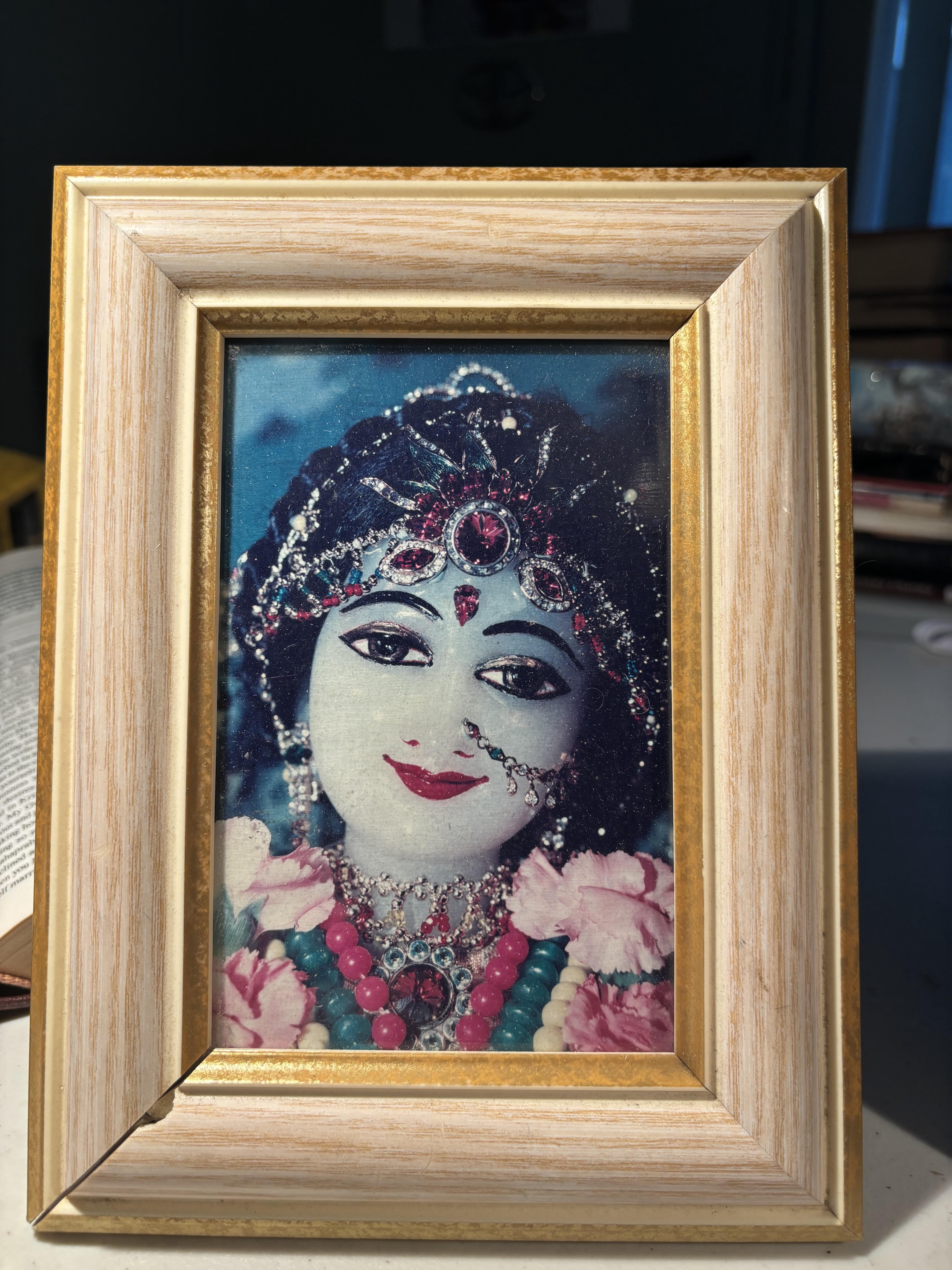
The benevolently smiling Srimatee Radharani of ISKCON Adelaide, South Australia, and feminine prototype.
To us the beautiful feminine expressions, rather then a negative, are to be celebrated as an expression of Krishna ‘s opulence, as in version 3 or The Bhagavad Gita As It Is Challenge 10.41:
10.41 Everything opulent and worthy of strong feelings or attention that may exist within the universe, all should be understood as only a part and fragment manifestation of My opulence. Actually they are born of My opulence.
Purport. Whether in the spiritual world or the material world, any glorified and beautiful existence should be understood to be but a fragmental manifestation of Krishna’s opulence. Anything extraordinarily opulent should be considered as a presentation of Krishna’s opulence.
And those who are unable to tolerate such “fragmental manifestations” of Krishna’s beauty and opulence, may take shelter in the forest, as Srila Prabhupada indicated once to His own monks and perhaps others in New York City.
“We are Krsna’s parts and parcels and have been created to give pleasure to Krsna. The chief pleasure potency is Radharani, and so Radha-Krsna are always together. Whereas the material energy is conducted by the external potency, Maya, the spiritual world is conducted by the internal potency, Radharani. We often pray to Radharani because She is the pleasure potency of Krsna. The very word “Krsna” means all-attractive, but Radharani is so great that She attracts Krsna. If Krsna is always attractive to everyone, and Radharani is attractive to Krsna, how can we imagine the position of Srimati Radharani? We should try humbly to understand and offer Her our obeisances, saying, “Radharani, You are so dear to Krsna. You are the daughter of King Vrsabhanu, and You are Krsna’s beloved. We offer our respectful obeisances unto You. Radharani is very dear to Krsna, and if we approach Krsna through the mercy of Radharani, we can easily attain Him. If Radharani recommends a devotee, Krsna immediately accepts him, however foolish he may be. Consequently in Vrndavana we find that devotees chant Radharani’s name more often than Krsna’s. Wherever we go in India we will find devotees calling, “Jaya Radhe.” We should be more interested in worshiping Radharani, for however fallen we may be, if somehow or other we can please Her, we can very easily understand Krsna. If we try to understand Krsna by the speculative process, we will have to spend many lifetimes of speculation; but if we take to devotional service and just try to please Radharani, then Krsna can be very easily realized. Radharani is such a great devotee that She can deliver Krsna.
Even Krsna cannot understand Radharani’s qualities. He fails to understand Her because She is so great. In order to understand Radharani, Krsna actually accepted Her position. Krsna thought, “Although I am full and complete in every respect, I still don’t understand Radharani. Why is that?” This obliged Krsna to accept the propensities of Radharani, and this accounts for His manifestation as Lord Caitanya Mahaprabhu. Caitanya Mahaprabhu is Krsna Himself, but He is Krsna accepting the propensities of Radharani. Radharani is always feeling separation from Krsna, and similarly, in the position of Radharani. Lord Caitanya was always feeling that separation. Furthermore, those who follow the teachings of Lord Caitanya should experience and relish the feelings of separation, not of meeting.
The Six Gosvamis, disciples of Lord Caitanya Mahaprabhu, the most perfect and highly elevated beings, never said, “I have seen Krsna.” Instead, they constantly cried, “Where is Radharani? Where are Lalita and Visakha and the other damsels of Vrndavana?” In their mature stage of love of Godhead, when they were living in Vrndavana, the Gosvamis, would also cry, “Radharani, where are You? Where are Your associates? Where are You, O son of Nanda Maharaja? Where are you all?” In this way they were searching after Krsna, and they never at any time said, “Last night I saw Krsna dancing with the gopis.” Such claims are not made by a mature devotee, but by one who takes things very cheaply. Some people think that Radha and Krsna are so cheap that They may be seen every night, but this is not the teaching of the Gosvamis, who were always searching after Krsna crying, “Where are You? Where are You Radharani? Where are You Krsna? Are You there by Govardhana Hill? Are You on the bank of the Yamuna?” In this way, throughout the whole tract of Vrndavana, the Gosvamis, were crying and searching after Radha and Krsna like madmen.
We have to follow in the footprints of the Gosvamis and search out Radha and Krsna in this way. Vrndavana is in our hearts, and we must search for Him there. This is the process recommended by Caitanya Mahaprabhu, the process of worship in separation. Feeling separation from Krsna, Lord Caitanya Mahaprabhu would throw Himself into the sea. Sometimes He would leave His room in the dead of night and disappear. No one would know where He had gone, but all the while He was searching after Krsna. Thus it is not that we are to enjoy the loving exchanges between Krsna and Radha like spectators at some sports show. We must feel separation from Them. The more we feel separation, the more we should understand that we are advancing. With our material senses, we cannot see Krsna, nor can we even hear His name. We can begin to perceive Him when we advance in devotional service. That devotional service begins with the tongue, not the legs, eyes or ears. The tongue must be utilized to chant
Hare Krsna, Hare Krsna, Krsna Krsna, Hare Hare
Hare Rama, Hare Rama, Rama Rama, Hare Hare
and take Krsna prasadam.
Thus the tongue has a dual function, and by utilizing it in this way, we will realize Krsna. We cannot see Krsna with our material eyes, nor hear about Him with material ears, nor touch Him with our hands; but if we engage our tongue in His service, He will reveal Himself, saying, “Here I am.”
This chanting of Hare Krsna extinguishes the blazing fire of material nature. This is also the purport to the following prayer to the spiritual master.
samsara-davanala-lidha-loka-
tranaya karunya-ghanaghanatvam
praptasya kalyana-gunarnavasya
vande guroh sri-caranaravindam **
“The spiritual master is receiving benediction from the ocean of mercy. Just as the cloud pours water on the forest fire to extinguish it, so the spiritual master extinguishes the blazing fire of material existence. I offer my respectful obeisances unto the lotus feet of my spiritual master.” (Sri Gurvastakam, Verse 1)
This material world is often compared to a forest fire which takes place automatically. No one wants a forest fire, but there is often lightning, or carelessness, or friction, or whatever, and the fire immediately takes place. Similarly, this material world is beset with a blazing fire of problems. Everyone wants to live here peacefully, but situations develop in such a way that this is not possible for anyone. We struggle very hard to adjust things in so many ways, but nature’s laws are so cruel and dangerous that in spite of our hopes and plans the blazing fire of the problems of material existence continues.
In this century, ( the twentieth ) for instance, we have attempted to put out the fire of war, but it has not been possible. There was a First World War, and then a League of Nations was formed to try to prevent a second, but despite their attempts a second took place. Now a United Nations has been constructed to help end war, but war is going on in Vietnam, in Egypt, in Pakistan and other places. No one wants a Third World War, but it seems imminent. It is not possible to send a fire brigade, a few men with buckets of water, to extinguish a great fire in the forest. To extinguish a roaring forest fire there must be volumes of water; in other words, there must be an arrangement that is beyond human endeavor. When there is a merciful cloud over the forest fire, the cloud bursts, rain pours down in torrents, and the blazing fire is immediately extinguished. As a cloud collects water from the ocean, similarly the spiritual master collects water from Krsna’s ocean of mercy and pours it over the blazing fire of material existence. Thus one who bestows or distributes the merciful rain of Krsna is called a spiritual master or guru.
In Vedic literatures it is said that in order to understand the transcendental science of Krsna consciousness, we must try to acquire knowledge of how to extinguish this blazing fire of problems. Scientists, philosophers and other educated men are trying very hard to extinguish it, but the result seems to be bigger and bigger bombs. The karmis or fruitive laborers are working with heart and soul, day and night, to extinguish this fire or to diminish the miserable condition of material existence by dint of hard labor. The jnanis or philosophers are also trying, but they have become disgusted and so proclaim, “This world is false.” Thinking this, they try to merge into the existence of the Supreme and in this way extinguish the fire. This is like the jackal who tries to pick some grapes from a vine, and when he fails, says, “Oh, these grapes are sour anyway.” The yogis or meditators try to gain superior mystic power by becoming greater than the greatest, smaller than the smallest, lighter than the lightest, and heavier than the heaviest, but this is just so much child’s play. With any material body — whether it be great or small, light or heavy — the problems of material existence still remain. In this way one may progress from one stage to another, coming from the stage of karmi or fruitive laborer, to the stage of jnani or philosopher, to the stage of yogi or meditator, but in any case one finally has to come to the platform of bhakti, or devotional service. This is the real evolutionary process. It is indicated in Bhagavad-gita in this way:
bahunam janmanam ante
Elevation to Krishna consciousness 5: Knowing Krsna’s Energies.
To be continued…..


 --The Australian Society for Krishna Culture. AUSKCULTURE, operation start 1984 -- ABN 65 231 425 870.